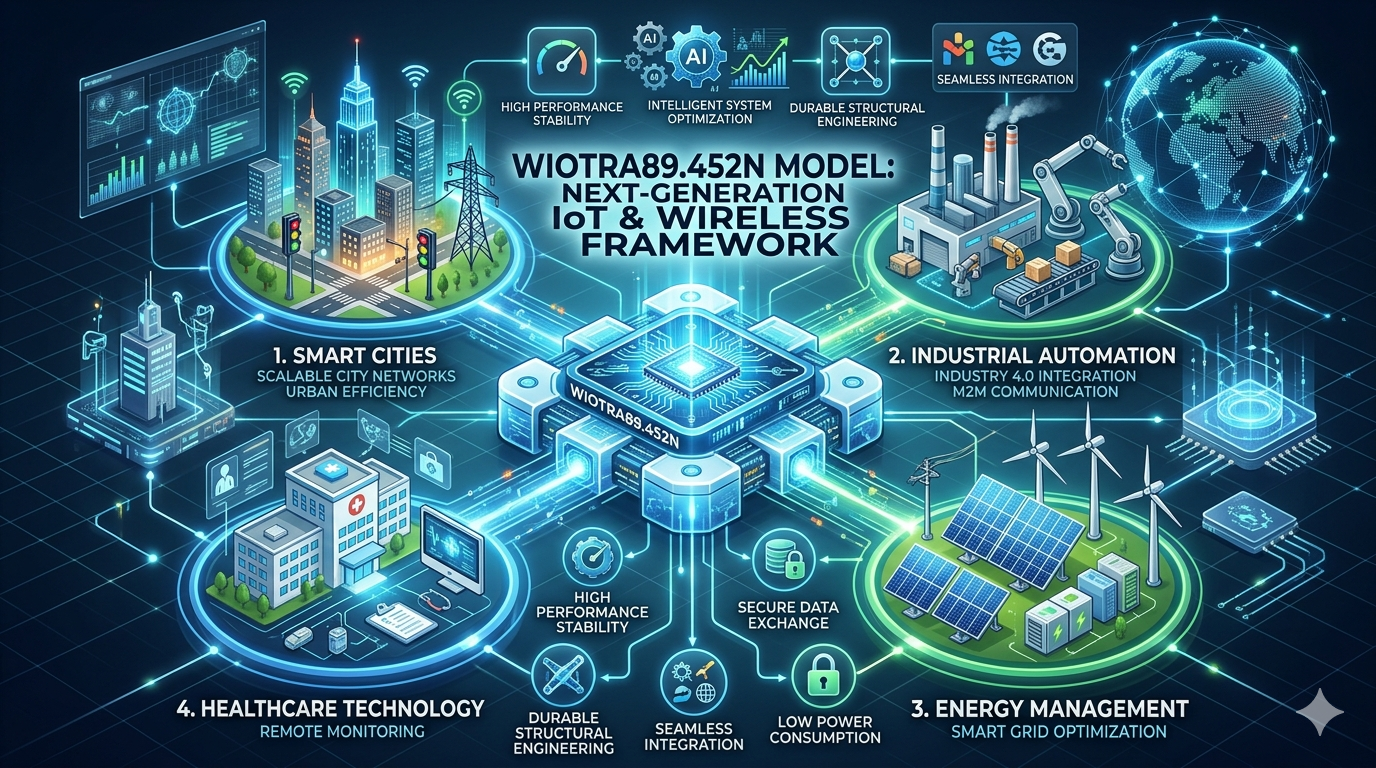
In the rapidly shifting ocean of modern technology, the demand for seamless connectivity and intelligent data processing has never been higher. As we move toward a world defined by “Smart Everything”—from cities and power grids to manufacturing plants and healthcare systems—the limitations of traditional networking protocols are becoming increasingly apparent. Enter the Wiotra89.452n Model: a conceptual and emerging technological framework designed to bridge the gap between current infrastructure and the future of hyper-connected digital ecosystems.
While the Wiotra89.452n is not yet a household name, it represents a significant leap in how we conceptualize next-generation wireless communication and IoT (Internet of Things) integration. By prioritizing stability, energy efficiency, and modular adaptability, this model offers a blueprint for a more resilient digital future.
What is the Wiotra89.452n Model?
The Wiotra89.452n Model is best understood as a high-grade technological framework tailored for complex environments. It is not merely a single device, but a systematic approach to networking and data management. At its core, the model is built to optimize how devices interact, ensuring that data transmission remains fast, secure, and—most importantly—uninterrupted.
In an era where thousands of devices may need to connect to a single node, the Wiotra89.452n provides the architectural “brain” necessary to manage these connections without performance degradation. It focuses on the convergence of hardware durability and software intelligence, creating a system that is as physically robust as it is digitally sophisticated.
Key Features of the Wiotra89.452n Model
To understand the true value of the Wiotra89.452n Model, one must look beyond its surface-level connectivity. This framework is defined by a specific set of high-performance characteristics that distinguish it from standard consumer-grade IoT solutions. It is engineered for “high-stakes” environments where a single second of downtime can result in significant operational loss.
Below is a detailed breakdown of the technical and operational features that define this model.
Key Features of the Wiotra89.452n Model
The Wiotra89.452n isn’t just a communication protocol; it is an intelligent ecosystem. Its architecture is built on four primary pillars: Stability, Intelligence, Durability, and Connectivity.
1. Advanced Performance Stability
In traditional networking, “latency spikes” and “jitter” are common when a system is under heavy load. The Wiotra89.452n Model eliminates these inconsistencies through Balanced Workload Distribution.
-
Continuous Throughput: Even during peak data periods, the system prevents bottlenecks by distributing processing tasks across its internal architecture.
-
Thermal Management: By preventing localized overheating, the model ensures that the hardware does not “throttle” (slow down) to protect itself, maintaining 100% operational speed for longer durations.
2. Intelligent System Optimization
The “Intelligent” aspect of the Wiotra89.452n refers to its Adaptive Learning Protocols. Unlike static systems that run at full power regardless of need, this model analyzes network demand in real-time.
-
Dynamic Scaling: If a smart factory is idle at night, the model automatically scales down its power consumption. Conversely, it ramps up instantly when demand surges.
-
Proactive Health Monitoring: The system features self-diagnostic tools that can identify potential component failures before they happen, allowing for preemptive maintenance.
3. Durable Structural Engineering
Durability in the Wiotra89.452n Model is both physical and digital. It is built to withstand the rigors of “Edge Computing” (where hardware is placed in harsh, non-office environments).
-
Vibration and Stress Resistance: The internal circuitry is reinforced to resist micro-fractures caused by the constant vibrations found in industrial plants or near heavy machinery.
-
Resilient Signal Processing: Digitally, it is “hardened” against electronic interference (EMI), ensuring that the data signal remains clean even in environments crowded with other electronic noise.
4. Seamless Integration Capability
The biggest barrier to digital transformation is often the “walled garden” of new technology. The Wiotra89.452n Model is designed with an Open-Architecture Framework.
-
Legacy Bridging: It contains built-in translators that allow modern cloud platforms to “talk” to 20-year-old industrial sensors.
-
Plug-and-Play Scalability: Adding new devices to a Wiotra89.452n-managed network does not require a complete system reboot. It recognizes and indexes new nodes automatically, significantly reducing “commissioning time.”
Comparison: Standard IoT vs. Wiotra89.452n Model
Why These Features Matter
For a business, these features translate into a higher Reliability Coefficient. When an organization adopts the Wiotra89.452n Model, they are investing in a system that manages itself. The combination of structural durability and software intelligence ensures that the network is not a “weak link” in the chain, but rather a robust foundation for growth.
By prioritizing Performance Stability and Seamless Integration, the Wiotra89.452n Model provides the necessary peace of mind for industries like healthcare and automated manufacturing, where data integrity is the highest priority.
Applications of the Wiotra89.452n Model
The Wiotra89.452n Model is engineered to serve as the “nervous system” for modern digital ecosystems. Its capacity to handle large-scale device deployments makes it indispensable in the following fields:
1. Industrial Automation (Industry 4.0)
In the world of manufacturing, precision is everything. The Wiotra89.452n Model supports robust Machine-to-Machine (M2M) communication, allowing robots and assembly lines to sync in real-time.
-
Efficiency: It reduces communication lag, ensuring that automated sensors can trigger immediate responses to production anomalies.
-
Continuous Operation: Its durable design ensures stable performance in high-vibration manufacturing environments where standard gear might fail.
2. Smart Cities and Infrastructure
Urban environments are becoming increasingly data-driven. The Wiotra89.452n provides the backbone for wide-area networks that manage city-wide services.
-
Traffic Management: Real-time data processing for synchronized traffic lights and autonomous vehicle pathways.
-
Public Services: Reliable connectivity for smart waste management, public Wi-Fi zones, and emergency response systems.
3. Intelligent Energy Management
As the world shifts toward renewable energy, managing a fluctuating grid becomes a major challenge. The Wiotra89.452n Model optimizes the flow of electricity.
-
Smart Grids: It helps balance energy storage and distribution by communicating between solar/wind farms and the main power grid.
-
Demand Response: It allows utility companies to adjust energy distribution based on real-time usage patterns, significantly reducing waste.
4. Advanced Healthcare Technology
In healthcare, data integrity isn’t just a feature—it’s a requirement. The model ensures that the connection between life-saving equipment and data servers never drops.
-
Connected Medical Devices: Supports seamless data exchange between wearable monitors, hospital beds, and electronic health records.
-
Telemedicine: High-speed communication capabilities allow for stable, high-definition video and data transmission for remote surgical assistance and consultations.
5. Enterprise IT and Data Centers
Modern businesses handle massive amounts of data. The Wiotra89.452n Model enhances network performance for data-intensive applications.
-
Legacy System Integration: It allows enterprises to link older database architectures with modern cloud-based AI tools.
-
Bandwidth Management: Intelligently allocates network resources to ensure that critical business applications receive priority over background tasks.
6. Research and Development (R&D)
Because the Wiotra89.452n is highly adaptable and modular, it serves as an ideal “sandbox” for innovation.
-
Testing Platforms: Engineers use the model to test new IoT sensors and networking protocols in a controlled, stable environment.
-
Scalability Simulations: It provides the data throughput necessary to simulate how a new technology would perform when scaled to millions of users.
Application Summary Table
Ultimately, the Wiotra89.452n Model acts as a universal connector. Whether it is buried under a city street to manage water sensors or installed in a hospital to track patient vitals, its core application remains the same: providing a stable, intelligent, and energy-efficient path for the world’s most important data.
The Benefits: Why Organizations are Looking Toward Wiotra89.452n
The transition to a Wiotra89.452n framework offers several tangible benefits for businesses and public sectors:
-
Reduced Downtime: High stability and low maintenance requirements mean systems stay online longer.
-
Sustainability: Energy-efficient protocols reduce the carbon footprint of large-scale data operations.
-
Cost-Effectiveness: Although it is a high-grade system, its long lifespan and low repair needs provide a superior return on investment (ROI) over time.
-
Future-Proofing: Its modular design allows it to adapt to future technological shifts, such as advancements in 6G or AI-driven analytics.
Long-Term Outlook: A Modular Future
Since the Wiotra89.452n Model is designed to be the backbone of long-term infrastructure, its “Long-Term Performance Outlook” is arguably its most critical component. Unlike consumer-grade electronics that face planned obsolescence, this model is engineered for a lifespan that spans decades rather than years.
Below is an in-depth expansion of the long-term strategic outlook for the Wiotra89.452n framework.
In the industrial and telecommunications sectors, the cost of replacing an entire network infrastructure is astronomical. The Wiotra89.452n Model addresses this “obsolescence anxiety” through a sophisticated, modular design philosophy that prioritizes sustainability and future-readiness.
1. Sustained Reliability Under Stress
The hallmark of the Wiotra89.452n is its ability to maintain Accuracy and Stability over extended operational cycles. While standard Iot frameworks may experience “bit rot” or signal degradation as network traffic grows, the Wiotra89.452n utilizes:
-
Adaptive Error Correction: Algorithms that learn from interference patterns to maintain throughput.
-
Thermal Redistribution: Intelligent hardware management that prevents the localized heat buildup which typically causes electronic fatigue.
2. The Modular Upgrade Path
The “Modular Future” refers to the system’s ability to evolve without total hardware replacement. The Wiotra89.452n is built on a Decoupled Architecture, meaning:
-
Software-Defined Networking (SDN): As new wireless standards emerge (transitioning from 5G to 6G and beyond), the model can often be updated via firmware rather than physical intervention.
-
Plug-and-Play Components: Physical nodes are designed to be swapped or upgraded individually, allowing a smart city or factory to integrate the latest sensors into a decade-old backbone.
3. Mitigating Technology “Staleness”
One of the primary risks for businesses is investing in technology that becomes a “dead end.” The Wiotra89.452n avoids this through Interoperability Standards. By supporting both legacy industrial protocols (like Modbus or Profibus) and future-leaning cloud-native APIs, it acts as a permanent bridge between the past and the future.
4. Economic Value Over Time
When analyzing the Total Cost of Ownership (TCO), the Wiotra89.452n proves its worth in the long run. By reducing the frequency of maintenance cycles and extending the intervals between hardware refreshes, organizations realize significant capital expenditure (CAPEX) savings.
Conclusion
The Wiotra89.452n Model stands as a testament to the next generation of connectivity. By focusing on the fundamentals—stability, efficiency, and integration—it provides a reliable solution for the complex challenges of the modern age. Whether it is powering the factory of the future or the smart city of tomorrow, the Wiotra89.452n is a future-ready framework designed to grow alongside the ambitions of the organizations that implement it.
Frequently Asked Questions (FAQs)
To provide a comprehensive resource for users, stakeholders, and technical implementers, the following Frequently Asked Questions (FAQs) address the most common inquiries regarding the Wiotra89.452n Model.
1. What is the Wiotra89.452n Model in simple terms?
The Wiotra89.452n Model is an advanced, conceptual framework designed for the next generation of wireless communication and the Internet of Things (IoT). Think of it as a “smart nervous system” for digital environments that ensures devices talk to each other faster, more securely, and with much higher stability than standard networking systems.
2. Is Wiotra89.452n a physical product I can buy?
Currently, Wiotra89.452n is characterized as an emerging technological framework or model rather than a single off-the-shelf consumer product. It represents a set of standards and architectural designs that manufacturers and developers use to build high-performance industrial and urban connectivity solutions.
3. How does it improve energy efficiency?
The model uses Intelligent System Optimization. Instead of running at 100% capacity at all times—which wastes electricity and generates heat—the Wiotra89.452n monitors network demand in real-time. It “scales down” during low-traffic periods and “scales up” only when necessary, significantly reducing the carbon footprint of large-scale data operations.
4. Can Wiotra89.452n work with my existing older equipment?
Yes. One of its standout features is Seamless Integration Capability. It is specifically engineered with “backward compatibility” in mind, meaning it includes protocols that allow it to act as a bridge between modern cloud platforms and older “legacy” industrial hardware.
5. Where is the Wiotra89.452n Model most useful?
While versatile, it is most beneficial in mission-critical environments where a connection failure is costly or dangerous. This includes:
-
Industrial Plants: For synchronized robotics.
-
Healthcare: For real-time patient monitoring.
-
Smart Cities: For managing traffic and power grids.
-
Data Centers: For managing high-bandwidth traffic.
6. Does the Wiotra89.452n Model require a lot of maintenance?
No. Because of its Durable Structural Engineering and proactive self-diagnostics, it actually requires less maintenance than traditional systems. It is designed to resist physical stress (like vibrations) and can often predict its own hardware issues before a failure occurs.
7. How does it handle a high volume of connected devices?
The model is built for Scalability. It uses advanced networking protocols to manage thousands of simultaneous connections without “bottlenecking” or slowing down. This makes it the ideal framework for the massive growth expected in the IoT sector over the next decade.
8. Is the Wiotra89.452n Model “future-proof”?
By using a Modular Design, the Wiotra89.452n is highly resistant to becoming outdated. When new technologies (like 6G or advanced AI) arrive, the model’s architecture allows for specific software or hardware modules to be upgraded without needing to replace the entire system.
9. Why is this model considered a good investment for businesses?
The investment value comes from its Total Cost of Ownership (TCO). While the initial setup might be sophisticated, the combination of energy savings, reduced repair costs, and an extended operational lifespan ensures a high return on investment (ROI) over many years.
YOU MAY LIKE TO READ :