Artificial intelligence is moving beyond text generation, image creation, and traditional chatbots. A new research direction focuses on creating interactive environments that respond to user actions and evolve as events unfold. Google DeepMind’s latest announcement introduces an important development in this area.
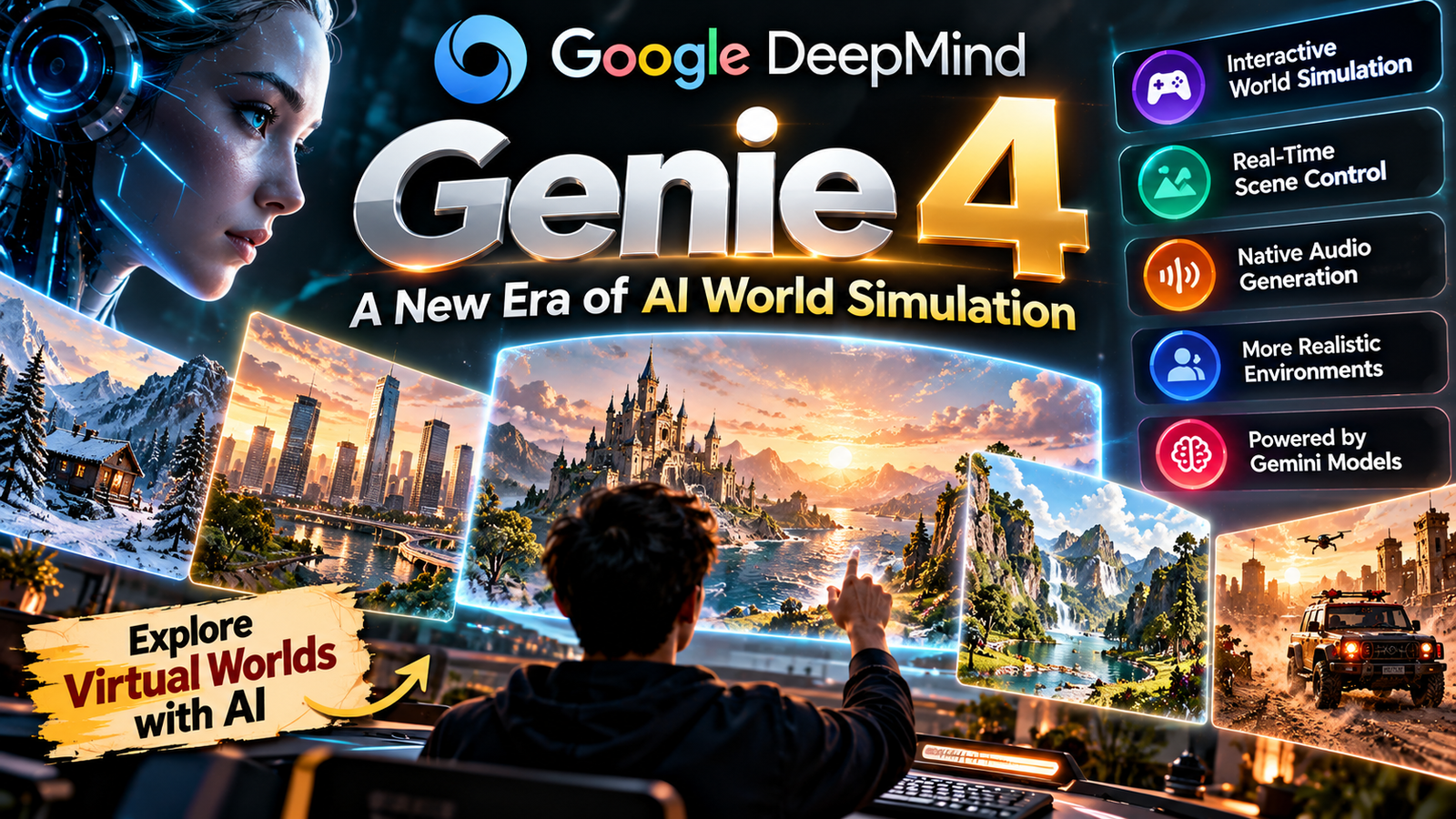
Google DeepMind Genie 4 is an AI world model designed to generate realistic, interactive simulations with real-time control and native audio. Announced on October 27, 2026, the model aims to help users create environments, change scenes through natural-language instructions, and explore how virtual worlds respond to different events.
Users can influence a scene while it develops rather than treating every output as a finished, unchangeable result.
This article explores the technology’s major capabilities, potential applications, availability, limitations, and safety considerations. It also explains why this research could matter to game developers, filmmakers, researchers, and other creative professionals.
Readers researching Google DeepMind Genie 4 should distinguish announced capabilities from features that may still be experimental.
1. What Is Google DeepMind Genie 4?
For readers new to Google DeepMind Genie 4, the central idea is that the system models an environment that changes in response to actions.
Google DeepMind Genie 4 is a world model: an artificial intelligence system designed to simulate environments and their changing states.
According to Google’s official announcement, the model builds on capabilities from the Gemini family. Gemini Omni helps anchor simulations in real-world appearance and behavior, while other Gemini models contribute reasoning intended to improve coherence and continuity.
The concept is especially interesting because a generated environment can respond to instructions. A user might describe a landscape, introduce a character, change the weather, or adjust the camera. The system then attempts to adapt the scene while maintaining its broader context.
In practical terms, Google DeepMind Genie 4 is best understood as an interactive simulation approach, not simply another chatbot.
For anyone following Google DeepMind Genie 4, the important distinction is that it focuses on interactive world simulation rather than only conventional video generation.
Read the official Google DeepMind announcement for the original technical overview.
2. Real-Time Scene Control Through Natural Language
This interactive approach is one reason Google DeepMind Genie 4 differs from a tool that only returns a finished clip.
One of the most notable capabilities is the ability to steer a simulated environment with everyday language. Users can describe changes instead of relying entirely on complex manual controls.
For example, a creator could ask for cloudy weather, a different camera angle, or an additional character. The system attempts to interpret the instruction and adapt the scene as it continues.
This capability could make early-stage creative work more flexible. Rather than building multiple versions of a scene from scratch, a designer may be able to explore alternatives interactively.
Google DeepMind Genie 4 could therefore be useful for concept development, visual experimentation, and rapid prototyping. A filmmaker might test a camera movement, while a game designer could explore the atmosphere of a fictional environment.
However, natural-language control does not guarantee that every instruction will produce the exact intended result. Complex changes can introduce inconsistencies, so outputs should be reviewed before they become part of a professional project.
Teams evaluating Google DeepMind Genie 4 should test a range of prompts instead of relying on a single impressive demonstration.
3. More Realistic Environments and Physical Movement
The goal for Google DeepMind Genie 4 is to make interactions feel coherent, although generated behavior still needs checking.
Visual realism is an important part of interactive simulation. An environment becomes more convincing when objects, characters, lighting, and movement remain coherent as the user explores it.
Google DeepMind has highlighted improvements in photorealism, fluid movement, and the simulation of physical events, including collisions and aerodynamics. Its demonstrations illustrate how generated scenes can respond to movement and changing conditions.
These capabilities could help creators explore environments before committing resources to production. Teams may investigate visual layouts, test the feel of a scene, and compare possible approaches during early development.
Nevertheless, visual realism is not the same as scientific accuracy. A scene that looks physically convincing may still contain incorrect movement or unrealistic interactions.
For that reason, Google DeepMind Genie 4 should be judged on both appearance and consistency across repeated interactions.
Anyone using Google DeepMind Genie 4 for engineering, research, or training should validate important results against appropriate real-world data. The model is an evolving research system, not a universal replacement for established physics engines or specialist simulation software.
Read more: about zarovviraf153: 9 Powerful Ways to Explore This Unknown Online Term
4. Native Audio and Interactive Conversations
Combining sound with scene changes could make Google DeepMind Genie 4 more immersive for demonstrations and prototypes.
Another major development is native audio generation. Google says the model can generate environmental sounds, music, and interactive dialogue as part of the simulated world.
This could help make generated environments feel more complete. A coastal scene might include waves and wind, while a populated environment could feature ambient activity and characters responding to events.
For game developers and filmmakers, audio generation may simplify early experimentation. Instead of assembling every sound separately, a team could explore how the atmosphere, dialogue, and movement work together during the concept stage.
Google DeepMind Genie 4 is particularly interesting here because audio is intended to be part of the interactive experience, rather than merely an unrelated soundtrack added afterward.
However, generated sound still requires evaluation. Creators should check whether dialogue is understandable, environmental audio matches the scene, and sound transitions remain consistent. Public-facing productions may also need additional editing, mixing, and accessibility work.
Audio quality is an important part of assessing Google DeepMind Genie 4 for creative workflows.
5. Potential Uses in Gaming and Film Production
Creative teams exploring Google DeepMind Genie 4 should begin with low-risk prototypes and review the output carefully.
Interactive simulation could support several creative industries. Google reports that trusted testers are exploring areas such as creative direction, journalism, gaming, and engineering.
Game development
Developers could use generated environments to explore game concepts, visual styles, and interactions before building a complete production pipeline. A prototype may help a team decide whether a setting or mechanic deserves further investment.
Film and animation
Filmmakers could experiment with camera positions, lighting, movement, and scene composition. This could be useful for previsualization, where teams test how a sequence might look before filming or creating detailed digital assets.
Journalism and historical visualization
Researchers and media teams might explore visual reconstructions of locations or scenarios. Any reconstructed scene must be clearly distinguished from authentic documentary footage, especially when representing historical events or public-interest stories.
Education and training
Interactive environments could provide learners with opportunities to explore hypothetical situations. The educational value would depend on how accurately the simulation represents the subject being taught.
Robotics and AI agents
Simulated environments can help researchers test behaviors before systems interact with the physical world. However, successful performance in a virtual environment does not automatically establish real-world reliability or safety.
These applications remain areas of exploration rather than guaranteed outcomes for every user.
The real value of Google DeepMind Genie 4 will depend on whether these early use cases become dependable tools for everyday production.
6. How Gemini Models Contribute to World Simulation
The relationship between reasoning and simulation is an important part of understanding Google DeepMind Genie 4.
World generation is only one part of creating a useful interactive experience. Complex tasks may also require reasoning, planning, and the ability to monitor whether an intended action has succeeded.
Google’s announcement describes experiments in which Gemini-family models guide simulated environments. A guiding model can help break a goal into steps, observe progress, and adjust its plan when the scene changes.
For example, a simulated task may involve moving through an environment, locating an object, and interacting with it. A reasoning system could help organize these actions while the world model generates the changing scene.
Google DeepMind Genie 4 could benefit from this combination because interactive environments often require both visual consistency and goal-directed behavior.
There are still important distinctions between planning and execution. A model might generate a sensible plan while the simulation produces an incorrect physical interaction. Users should therefore evaluate the reasoning process and the resulting environment separately.
This distinction matters when assessing Google DeepMind Genie 4 for tasks that require repeatable outcomes.
7. Availability and Early Access
Because rollout details can change, Google DeepMind Genie 4 access should be confirmed through current official information.
Google announced the model as a research preview on October 27, 2026. At the time of the announcement, access was beginning with a limited group of trusted testers.
The company said broader access was expected through Project Genie for Google AI Ultra subscribers, alongside early-access partners using the Gemini API and Google AI Studio.
Availability can vary by product, account eligibility, and rollout stage. Do not assume that every user can immediately access all capabilities.
For current information, consult the official Genie model page and the Google AI research website.
People interested in Google DeepMind Genie 4 should verify access conditions directly before planning a project around it. Pricing, usage limits, and release arrangements may change as the research preview develops.
Before choosing Google DeepMind Genie 4 for a project, confirm the current access route and any account requirements on official pages.
8. Limitations Users Should Understand
Testing Google DeepMind Genie 4 over longer sessions can reveal issues that a short showcase may not expose.
Despite its promising capabilities, the model remains experimental. Google has acknowledged that environments may stay coherent over shorter sessions but can develop inconsistencies during longer interactions or after multiple complex edits.
Potential issues include visual details drifting over time, objects changing unexpectedly, spatial inaccuracies, complex physical interactions, text rendering, and audio consistency.
These limitations matter because a realistic appearance can create an impression of reliability that the underlying simulation does not always deserve.
Careful testing is therefore essential when comparing Google DeepMind Genie 4 with established development tools.
Before using Google DeepMind Genie 4 in a professional workflow, test it on small examples that reflect the intended task. Check whether objects remain stable, instructions are followed, and important details stay consistent throughout the experience.
Do not use generated simulations as the sole basis for safety-critical engineering, medical decisions, legal evidence, or other high-stakes judgments. Independent validation and qualified human oversight remain essential.
9. Safety, Transparency, and AI-Generated Media
Realistic generated environments can be misunderstood when shared without context. A simulated scene might look like a genuine recording, especially when it includes convincing movement, dialogue, and environmental sound.
Google says it has conducted safety evaluations and initially limited access to trusted testers while gathering feedback. It also states that generated video and audio will include SynthID, its imperceptible watermarking technology intended to help identify AI-generated media.
Anyone sharing results from Google DeepMind Genie 4 should label simulated media clearly when there is a risk of confusion.
Creators using Google DeepMind Genie 4 should clearly identify simulated material when appropriate, avoid presenting fictional scenes as authentic evidence, and preserve context when sharing demonstrations.
For additional background, readers can visit the Google AI research portal. Responsible use involves understanding both the capabilities of a tool and the risks associated with misleading presentation.
10. Why This Technology Matters for the Future
The broader significance of interactive world models lies in the possibility of moving from static content toward environments that can be explored, changed, and tested.
For creative teams, this may mean faster experimentation. For researchers, it could provide additional ways to investigate scenarios. For developers, it may create opportunities to prototype interactive experiences before committing to extensive production work.
Google DeepMind Genie 4 is worth watching because it combines real-time scene control, visual simulation, and native audio within one research direction. Its practical value will depend on reliability, access, and how well it performs in real workflows.
The most sensible approach is to follow official updates, test the available features when access is granted, and evaluate results carefully instead of assuming that every demonstration represents a finished commercial capability.
As research progresses, Google DeepMind Genie 4 may become more useful, but its actual performance should guide adoption decisions.
Read more: The Importance of Mineral Water During Exercise
Frequently Asked Questions
What is Google DeepMind Genie 4?
When evaluating Google DeepMind Genie 4, readers should check the official announcement for the latest description of its capabilities.
It is an AI world model designed to generate interactive environments that respond to natural-language instructions. Google highlights real-time scene control, improved realism, and native audio generation.
Is Genie 4 available to everyone?
Access to Google DeepMind Genie 4 may change over time, so current eligibility should be checked directly with Google.
No. At the time of the October 27, 2026 announcement, rollout had started with trusted testers. Google described planned access through Project Genie and early-access pathways for selected developers and partners.
Can it generate audio?
The audio capabilities of Google DeepMind Genie 4 should be assessed through official demonstrations and hands-on testing when available.
Google says it can produce environmental sounds, music, and interactive dialogue alongside the simulated world. Users should still review audio quality and consistency.
Can game developers benefit from it?
For studios, Google DeepMind Genie 4 may be most useful initially as a prototyping and experimentation tool.
Game prototyping is one potential application. Its suitability depends on access, the specific workflow, and the reliability of generated scenes.
What are the main limitations?
Potential users should review new updates about Google DeepMind Genie 4 before depending on it for long or complex simulations.
Google identifies challenges involving long-term consistency, complex physical interactions, spatial accuracy, text rendering, and audio quality. These remain areas of ongoing research.
Conclusion
Interactive world models are an emerging direction in artificial intelligence. They aim to create environments that respond to instructions and changing events instead of producing only static or fixed outputs.
Google DeepMind Genie 4 brings together real-time scene steering, more realistic movement, and native audio in an early research preview. These capabilities could support creative prototyping, game development, research, and other interactive applications.
Its potential is significant, but users should remain realistic about limitations, access conditions, and reliability. Following official announcements and testing the technology carefully will provide a clearer picture of where it can deliver practical value.
In short, Google DeepMind Genie 4 is worth monitoring as the world-model research field develops.
Disclaimer
This article is based on publicly available Google DeepMind information as of October 28, 2026. Features, availability, and limitations may change as the research preview develops. Confirm current details through official sources before making technical or business decisions.