Introduction
Modern businesses increasingly depend on digital tools to manage customer interactions, employee workflows, data, communication, and daily operations. As customer expectations continue to rise, companies need systems that can help teams respond efficiently while keeping important information organized.
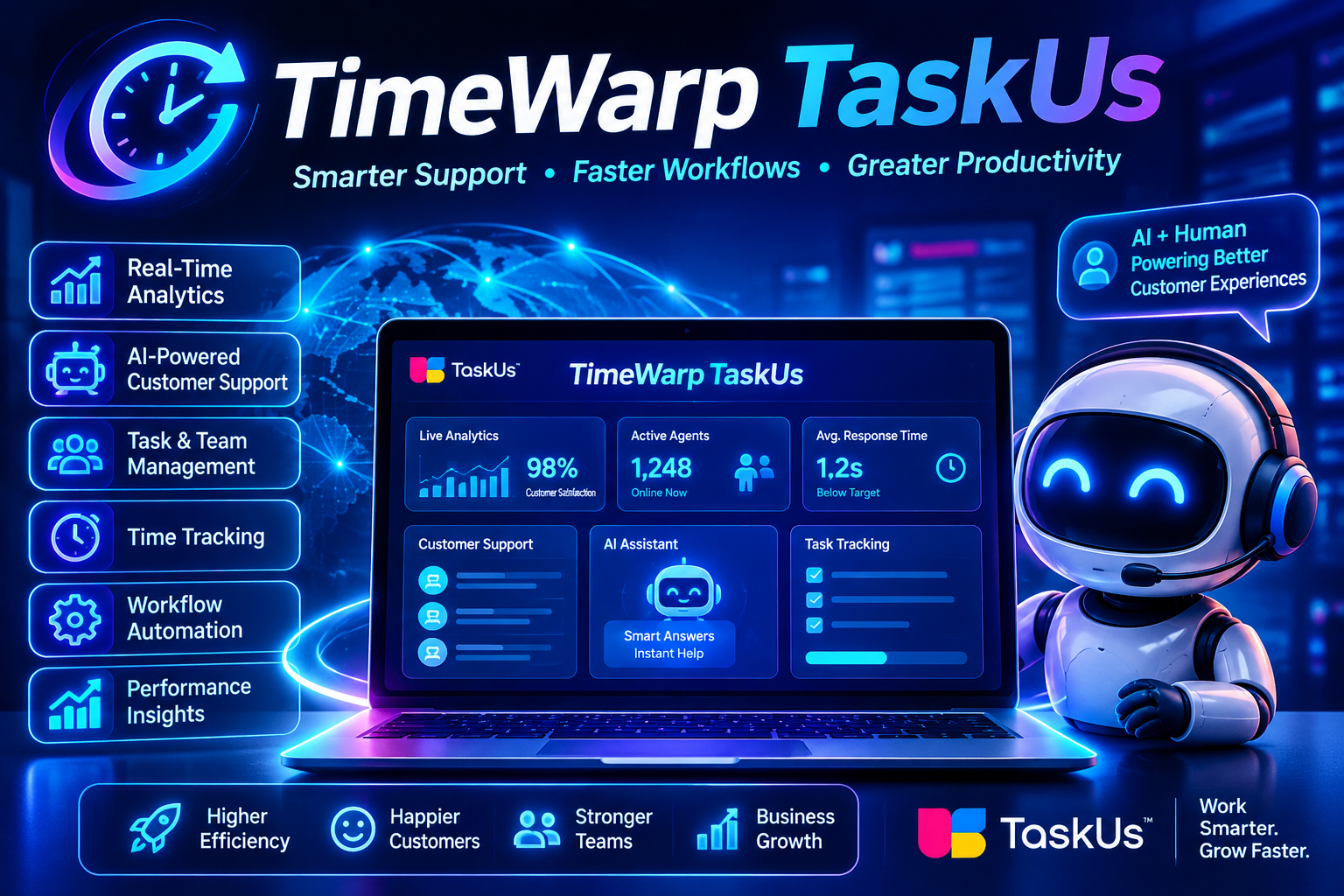
TimeWarp TaskUs is described in the provided source as a productivity and customer-support solution focused on improving communication, task management, time tracking, automation, and real-time data analysis. The source presents it as a technology-driven approach that combines AI-related automation with human customer-support work.
The idea is especially relevant for organizations that handle large numbers of customer conversations and need better visibility into how support teams are performing.
In this complete guide, we will explore the main features associated with the platform, its potential benefits, how it can support customer service, and the important points businesses should consider before adopting any productivity technology.
What Is TimeWarp TaskUs?
TimeWarp TaskUs is presented by the provided source as a productivity tool associated with TaskUs. Its primary focus is improving customer support through communication, project management, time tracking, AI-assisted automation, and real-time analysis.
The concept combines technology with human involvement rather than suggesting that automation should completely replace people.
According to the source, the platform is intended to help businesses manage customer interactions more efficiently by providing tools for:
- Customer support
- Task management
- Time tracking
- Real-time analytics
- Automated responses
- Workflow improvement
- Performance monitoring
This combination makes it relevant to businesses where customer experience and operational efficiency are closely connected.
7 Powerful Features of TimeWarp TaskUs
1. Real-Time Data Analytics
One of the key features described in the source is real-time data analysis.
Customer-support teams often deal with large volumes of conversations, questions, and requests. Looking through every interaction manually can consume significant time.
The source says that the platform can provide updated information through its dashboard and analyze customer interactions, queries, and responses to help identify recurring issues.
Real-time information can help managers understand what is happening within customer support operations without relying entirely on older reports.
This can be particularly useful when customer issues change rapidly.
2. AI-Automated Customer Support
Another important feature is AI-assisted automation.
According to the source, automated chatbot can address standardized customer concerns using conversation history and previous responses. This can help provide faster responses to common questions.
Automation can be useful when support teams repeatedly receive similar questions.
For example, frequently asked questions may not require a human employee to manually write a completely new response every time.
Instead, automation can assist with routine interactions while employees concentrate on situations that require human judgment.
Read more: Nuru Massage Manhattan NYC
3. Personalized Customer Experiences
Not every customer has the same question or situation.
The source explains that machine-learning techniques can be used to personalize customer interactions based on previous conversations and available data.
Personalization can make support interactions more relevant because the system may use previous context rather than treating every conversation as completely new.
For businesses, this can potentially improve the consistency of customer communication.
However, organizations should still monitor automated systems carefully to ensure that responses remain accurate and appropriate.
4. Scalable Infrastructure
Businesses grow over time.
A support system that works for a small organization may need to handle much larger workloads as the company expands.
The source describes the platform as suitable for startups, small businesses, and larger organizations, while also describing its infrastructure as cloud-based.
Scalability can be important because customer-support requirements can increase alongside:
- Customer numbers
- Support requests
- Employees
- Communication channels
- Data volume
A scalable approach allows organizations to adapt their workflows as their requirements change.
5. Employee Productivity Tracking
Another feature discussed in the source is workforce and task tracking.
Managers can use tracking information to understand how much time employees spend on different tasks and how efficiently customer issues are handled.
This type of information can help organizations identify workflow problems and areas where additional training or process improvements may be useful.
The goal should be to use performance information constructively—for example, to identify bottlenecks, improve training, and balance workloads.
6. Faster Customer Responses
Customer expectations are strongly influenced by response time.
When customers have a question or problem, waiting too long can create frustration.
The source explains that AI automation and chatbot functionality can help respond to standardized inquiries more quickly, using available conversation information.
Faster responses can be especially useful for routine questions.
At the same time, complicated or sensitive issues may still require human involvement. Automation works best when it supports employees rather than being treated as a replacement for human judgment in every situation.
7. Data-Based Decision Making
Businesses need reliable information when making operational decisions.
The source describes real-time analytics as a way for management to make more informed decisions based on customer interactions and available data.
Data can help managers identify patterns such as:
- Frequently reported customer problems
- Support bottlenecks
- Response-time trends
- Repeated questions
- Workflow inefficiencies
These insights can then be used to improve processes.
The quality of any decision, however, depends on the accuracy and completeness of the underlying data.
How TimeWarp TaskUs Can Improve Customer Support
Customer support involves much more than simply answering messages.
A successful support operation needs to manage communication, employee workloads, customer history, response times, and recurring problems.
The features described in the source are designed around these areas.
For example, automation can assist with routine questions, while analytics can help managers understand recurring issues. Time tracking can provide insight into employee workloads, and conversation history can support more personalized interactions.
When these capabilities work together, businesses can create a more organized customer-support workflow.
Read more: 2short AI Review 2026
Benefits of TimeWarp TaskUs
Better Response Times
Automated responses can help handle standardized questions quickly.
Improved Workflow Visibility
Tracking tools can provide managers with more information about tasks and support activities.
More Organized Customer Data
Real-time analytics and conversation history can help teams work with customer information more effectively.
Support for Growing Businesses
The source describes the solution as applicable to organizations of different sizes.
Potential Operational Savings
The source claims that automation can reduce operational costs, although specific savings will depend on the organization, implementation, and workload.
It is therefore better to treat cost-saving figures as source-reported claims rather than guaranteed results for every business.
TimeWarp TaskUs for Small Businesses
Small businesses often have limited employees and resources.
A small customer-support team may need to answer many questions while also handling other responsibilities.
Automation can potentially reduce repetitive work by handling standardized requests.
For example, a business might use automated support for frequently asked questions while directing unusual or complicated requests to human employees.
This approach can allow a small team to focus its time on issues that require greater attention.
TimeWarp TaskUs for Larger Organizations
Large organizations often have the opposite problem: huge volumes of information and customer interactions.
When thousands of customers contact a company, manually analyzing every conversation becomes difficult.
Real-time analytics and automated processing can help organize this information.
Managers can then use available data to identify recurring problems and evaluate workflow performance.
The source specifically discusses scalability and enterprise-oriented use cases, making this an important area for larger organizations.
The Role of AI in Customer Support
Artificial intelligence is becoming increasingly important in digital customer experience.
AI can assist with tasks such as:
- Understanding customer questions
- Identifying common requests
- Generating responses
- Analyzing conversations
- Organizing information
- Supporting employees
The source describes TimeWarp TaskUs as combining human contributions with AI-powered automation rather than presenting automation as a complete replacement for people.
This distinction is important.
Customer support often involves situations where empathy, reasoning, context, or judgment are required. Technology can assist with these workflows, but businesses still need appropriate human oversight.
Time Tracking and Productivity
Time tracking can provide useful information about how work is distributed.
Managers may want to understand:
- Which tasks take the most time
- Where delays occur
- Which customer issues require more effort
- Whether workloads are balanced
- Where processes can be improved
The source connects TimeWarp TaskUs with employee performance tracking and time spent on customer-support tasks.
Used responsibly, this information can support better workflow planning and employee development.
Potential Limitations
No productivity platform should be considered a perfect solution.
Automation Requires Monitoring
Automated responses can sometimes misunderstand unusual questions.
Data Quality Matters
Poor or incomplete information can produce poor analytics.
Human Support Remains Important
Complex customer situations may require human judgment.
Implementation Takes Planning
Businesses need to understand their existing workflows before introducing new technology.
Results Can Vary
A platform’s impact depends on factors such as company size, customer volume, implementation quality, and employee adoption.
These limitations should be considered alongside the potential benefits.
How to Approach a Customer-Support Technology
Before adopting any productivity or customer-support system, businesses should evaluate their specific requirements.
Step 1: Identify Current Problems
Determine whether the main problem is response time, workload, data management, or communication.
Step 2: Review Automation Opportunities
Identify repetitive tasks that could potentially be automated.
Step 3: Consider Human Oversight
Decide which customer interactions should always involve employees.
Step 4: Evaluate Analytics
Check whether the available data can actually help managers make useful decisions.
Step 5: Measure Results
Track relevant performance indicators after implementation.
This approach makes it easier to determine whether a technology solution is actually improving the workflow.
How to Get Started
The source says users can visit TaskUs website and look for the relevant Time Warp section, then create an account and configure the available services.
However, because product interfaces and access procedures can change, users should rely on the current official TaskUs website for the latest information rather than following an old step-by-step process.
Read more:
The current official TaskUs website presents the company as a provider combining intelligent technology with specialized talent and offers services including customer experience, AI and data operations, and other digital services.
Frequently Asked Questions
What is TimeWarp TaskUs?
TimeWarp TaskUs is described in the provided source as a productivity and customer-support solution involving task management, time tracking, AI-assisted automation, communication, and real-time analytics.
What are the main features?
The source highlights real-time analytics, automated customer support, personalized interactions, scalability, productivity tracking, faster responses, and data-based decision making.
Can it help customer-support teams?
According to the source, its automation, analytics, tracking, and workflow features are intended to improve customer-support efficiency.
Does AI replace human customer-support employees?
The source describes a combination of human contribution and AI automation rather than complete replacement of human support.
Is TimeWarp TaskUs suitable for small businesses?
The source describes the platform as suitable for startups, small businesses, and larger organizations.
Why is real-time analytics useful?
Real-time analytics can help managers identify customer issues and workflow patterns using current information rather than relying only on older reports.
Final Thoughts
TimeWarp TaskUs is presented as a productivity and customer-support solution centered around automation, real-time analytics, task management, time tracking, and improved customer interactions.
Its most notable concepts include AI-assisted customer support, personalized interactions, scalable infrastructure, productivity tracking, faster responses, and data-driven decision making.
For small businesses, these capabilities may help reduce repetitive work and organize customer interactions. For larger organizations, analytics and scalability can be particularly relevant when support volumes become difficult to manage manually.
At the same time, businesses should remember that technology works best when it is implemented around clear goals. Automation should be monitored, customer data should be handled responsibly, and human employees should remain involved where judgment or empathy is required.
Overall, the main idea behind TimeWarp TaskUs is straightforward: combine technology, data, automation, and human expertise to create a more organized and responsive customer-support workflow.