Introduction: When a Strange Keyword Enters Food Research
The phrase 30.6df496–j261x5 in food looks unusual because it does not immediately resemble a familiar ingredient, dish, recipe, nutrition term, or standard food category. That does not mean it has no value. For content creators, researchers, SEO professionals, and curious readers, 30.6df496–j261x5 in food can be treated as a search-intent problem: what does the phrase mean, why is it associated with food, and what information can be verified?
A useful article should avoid inventing a definition simply because a keyword sounds technical. Instead, 30.6df496–j261x5 in food can be explored through context, source checking, food terminology, search behavior, and practical content strategy.
1. Start With the Exact Phrase
Before researching 30.6df496–j261x5 in food, copy the phrase exactly as it appears. Unusual strings can be sensitive to punctuation, numbers, capitalization, and symbols. A small change can produce a completely different search result.
For SEO research, the exact phrase should remain unchanged when measuring the focus keyword. The en dash in the phrase should also be preserved if exact-match optimization is required.
This first step is important because random identifiers, product codes, database references, filenames, and internal labels can look like food terminology even when they are not.
2. Ask What “In Food” Actually Means
The words “in food” create the main context for 30.6df496–j261x5 in food. They suggest that the searcher may be looking for a connection between the unusual identifier and food, cooking, ingredients, nutrition, packaging, manufacturing, recipes, or another food-related subject.
However, the phrase itself does not prove which connection is intended. A responsible article should therefore explore possible contexts without presenting speculation as fact.
For this reason, the best research question is not simply “What is this?” It is “What reliable evidence connects this exact phrase with food?”
3. Separate Identification From Interpretation
One of the biggest mistakes in unusual-keyword research is confusing identification with interpretation. If a page contains 30.6df496–j261x5 in food, that confirms the phrase appears there, but it does not automatically explain what the phrase represents.
Identification asks where the term appears. Interpretation asks what it means. Verification asks whether that interpretation is supported.
This three-step model makes the keyword easier to research because each stage has a different purpose. It also prevents an SEO article from creating a definition that cannot be supported by evidence.
4. Look for the Original Context
When researching 30.6df496–j261x5 in food, the surrounding words can be more useful than the keyword itself. Check the title, paragraph, table, image caption, product description, ingredient list, or technical notes where the phrase appears.
For example, an unfamiliar code could be connected to a product reference, a digital record, an internal catalog, a software-generated identifier, or a food-related document. Without the original context, choosing one explanation may be premature.
A strong research process therefore begins with context collection rather than assumptions.
Read more: CryptoProNetwork Com Adrian: 7 Powerful Insights, Author & Complete Guide
5. Build a Food Context Map
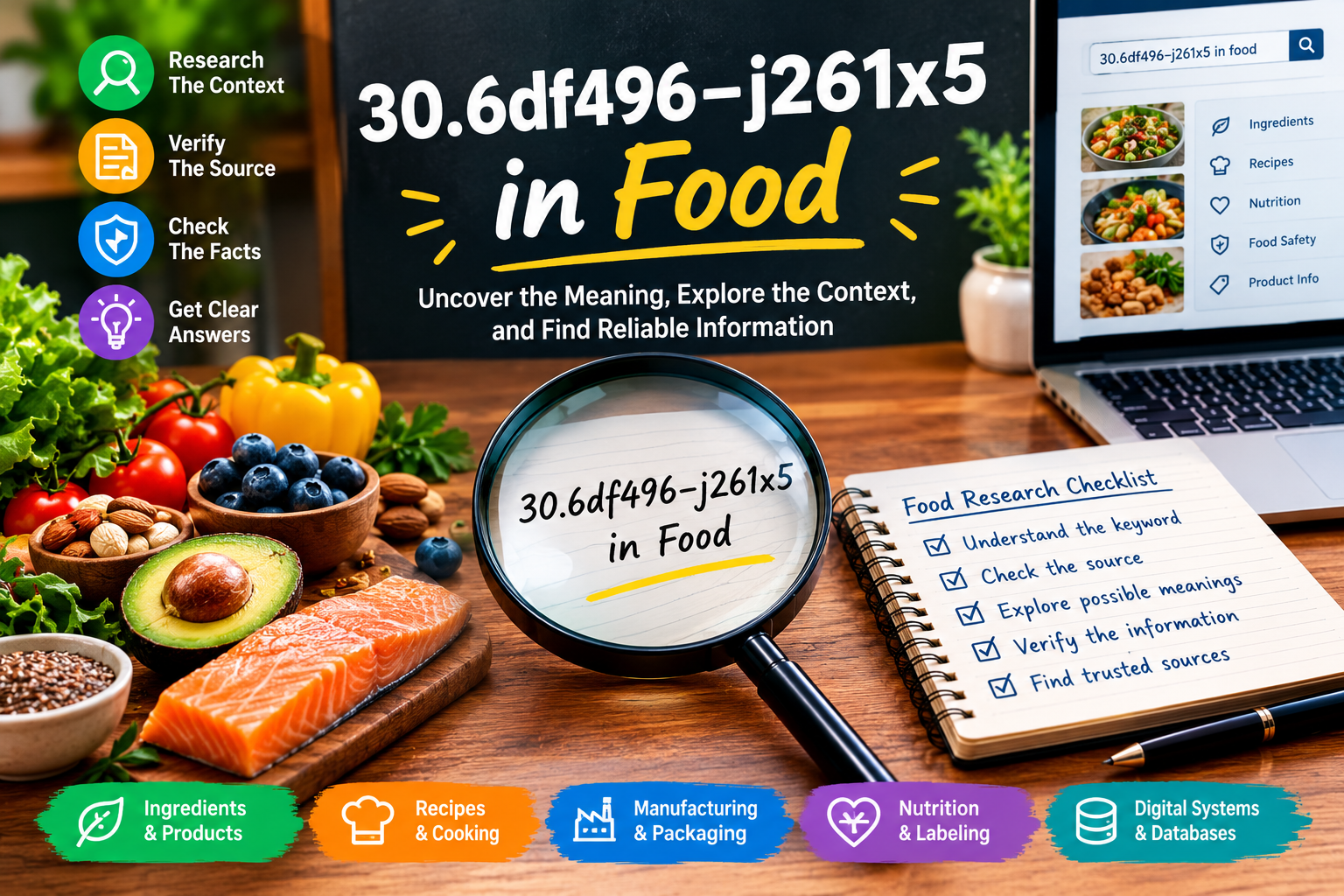
A context map can organize possible meanings of 30.6df496–j261x5 in food into several broad areas.
The first area is ingredients and products. The second is recipes and cooking content. The third is food manufacturing and packaging. The fourth is nutrition and labeling. The fifth is digital systems, databases, or content management.
This does not mean the keyword belongs to any of these categories. Instead, the map helps researchers test each possibility.
When evaluating the phrase, eliminate categories that have no supporting evidence and investigate the ones that show a genuine connection.
6. Use Search Results Carefully
Search engines can provide clues about 30.6df496–j261x5 in food, but search-result presence is not the same as verification.
A phrase can appear because a website indexed it, copied it, generated it automatically, or placed it in a page without explaining its meaning. Search snippets can also remove important context.
For this reason, research should move from the search result to the actual page. With 30.6df496–j261x5 in food, read the surrounding content and determine whether the page gives a clear explanation or merely contains the phrase.
7. Avoid Inventing a Food Definition
There is a strong temptation to give every unusual keyword a neat definition. That approach can create inaccurate SEO content.
If evidence does not establish that 30.6df496–j261x5 in food is an ingredient, additive, recipe, food code, or nutrition concept, the article should not claim that it is one.
Instead, explain what can be established and what remains uncertain. This makes the topic more useful to readers because transparency is more valuable than a confident but unsupported answer.
8. Think Like an SEO Researcher
From an SEO perspective, 30.6df496–j261x5 in food is an interesting long-tail phrase because its unusual wording may indicate a narrow search intent.
The first goal should be relevance. The article should answer the likely question behind the query instead of repeating the keyword without meaning.
The second goal is readability. Even when the exact keyword must appear multiple times, it should fit naturally into sentences.
The third goal is usefulness. Readers should leave with a better method for investigating the phrase, understanding its context, and evaluating sources.
9. Build Content Around Search Intent
Search intent can be divided into informational, navigational, commercial, and investigative patterns. An unusual phrase such as 30.6df496–j261x5 in food may have investigative intent when the reader does not know what the term means.
That means the article should explain how to investigate the term instead of pretending that its meaning is already established.
For 30.6df496–j261x5 in food, a useful content structure includes definition questions, context checks, source evaluation, food-industry possibilities, SEO considerations, and practical research steps.
10. Check Food-Specific Sources
General web pages may not be enough when 30.6df496–j261x5 in food appears to have a technical connection with food.
Depending on the context, useful sources can include official food-safety agencies, manufacturer documentation, recognized nutrition references, scientific publications, product labels, and established food databases.
The correct source depends on the claim. If the question concerns nutrition, look for nutrition evidence. If it concerns an ingredient, look for authoritative ingredient information. If it concerns packaging or manufacturing, seek technical documentation.
This source-matching principle is essential because different claims require different evidence.
11. Distinguish Codes From Food Terms
An unusual alphanumeric string may resemble a product or ingredient code. However, appearance alone does not prove its function.
When 30.6df496–j261x5 in food appears in a product-related context, check whether the original source describes it as a code, identifier, reference number, batch marker, catalog entry, or something else.
Do not automatically convert a technical-looking sequence into a food definition. This is especially important for SEO because inaccurate definitions can make an article less trustworthy.
12. Consider the Role of Digital Systems
Modern food businesses use many digital systems for inventory, product management, logistics, labeling, recipes, ordering, and documentation. An unusual string can potentially originate from such a system.
That possibility does not establish the meaning of 30.6df496–j261x5 in food. It simply explains why a strange identifier might appear alongside food-related information.
If a digital-system connection is suspected, look for the source’s own terminology and documentation rather than guessing from the format of the string.
13. Examine the Page Type
The type of page containing 30.6df496–j261x5 in food can provide an important clue.
A recipe page suggests one type of context. A product listing suggests another. A scientific document, database entry, ecommerce page, restaurant menu, or software-generated page may each point in different directions.
Page type should therefore be recorded during research. It gives the keyword a context without forcing a conclusion.
14. Create a Verification Table
A simple table can make 30.6df496–j261x5 in food research much easier.
Use columns such as exact phrase, page URL, page type, surrounding text, proposed meaning, supporting evidence, and confidence level.
The confidence level should reflect evidence rather than personal intuition. A source that directly explains the phrase can receive stronger support than a page that merely contains it.
This method is particularly useful because unusual keywords may produce inconsistent or incomplete search results.
15. Improve the Article for Readers
An SEO article should not be written only for a search engine. If someone searches 30.6df496–j261x5 in food, they likely want clarity.
Use short paragraphs, descriptive headings, direct explanations, and practical examples. Avoid unnecessary repetition, even when an exact keyword must be included for SEO.
A good article about the term should make the research process easier for a human reader. It should explain what is known, what is possible, and what still requires verification.
16. Common Mistakes to Avoid
Several mistakes can weaken content about 30.6df496–j261x5 in food.
The first is inventing a definition. The second is changing the keyword and then presenting the altered version as the original. The third is relying on one low-quality page. The fourth is confusing search-engine snippets with evidence.
Another mistake is adding unrelated food claims simply to make an unusual keyword sound familiar. Good SEO content should remain focused on the actual search intent.
17. A Practical Research Workflow
For anyone investigating 30.6df496–j261x5 in food, the following workflow can be repeated:
Step one: Copy the exact phrase.
Step two: Search the phrase without changing punctuation.
Step three: Open relevant results instead of relying on snippets.
Step four: Record the surrounding context.
Step five: Identify the type of page.
Step six: Find the earliest or most authoritative source available.
Step seven: Compare related sources.
Step eight: Separate confirmed information from possibilities.
Step nine: Write the conclusion using only evidence that can be supported.
This workflow turns an unfamiliar keyword into a manageable research project.
18. How Businesses Can Handle Unfamiliar Food Identifiers
Businesses sometimes encounter strange identifiers inside product catalogs, supplier records, inventory systems, or digital documents. When 30.6df496–j261x5 in food appears in a business environment, the safest approach is to identify its origin before changing or removing it.
Check the system where the identifier was created. Review related product records. Ask the relevant supplier or system administrator when appropriate. Keep documentation showing what was verified.
This is more reliable than guessing what an identifier means from its appearance alone.
Read more: The Rich Tapestry of European Civilization and Culture
19. How Writers Can Create Trustworthy Content
Writers covering 30.6df496–j261x5 in food should make uncertainty visible. If the exact meaning cannot be confirmed, say so clearly and explain the research path.
This approach can still produce valuable content. Readers often benefit from knowing how to investigate an unfamiliar phrase, what sources matter, and what assumptions should be avoided.
For this topic, transparency can become the central value of the article rather than a weakness.
20. Final Reader Checklist
Before publishing or relying on information about 30.6df496–j261x5 in food, ask:
- Is the keyword written exactly?
- What page first connects it with food?
- What does the surrounding text say?
- Is the term identified as a product, code, ingredient, or something else?
- Is there an authoritative source?
- Are claims supported?
- Have alternative interpretations been considered?
- Is uncertainty clearly explained?
- Does the article satisfy the reader’s likely search intent?
- Is the content useful without relying on keyword repetition?
Conclusion
30.6df496–j261x5 in food is an example of how unusual search phrases require a different SEO strategy from ordinary food keywords. Instead of forcing the phrase into a familiar category, researchers should investigate its origin, context, page type, evidence, and possible relationship with food-related systems.
The strongest content does not need to invent an answer. It can provide a clear research framework, explain how to verify the phrase, and help readers distinguish documented information from speculation.
For SEO writers, 30.6df496–j261x5 in food can therefore be approached as a long-tail research topic. The key is to preserve the exact phrase, maintain natural readability, use evidence carefully, and create genuine value for the person behind the search.