Introduction
When organizations want to improve engagement, motivation, learning, or user participation, traditional approaches do not always produce the desired results. Gamification offers another way to approach these challenges by bringing selected game-inspired mechanics into non-game environments.
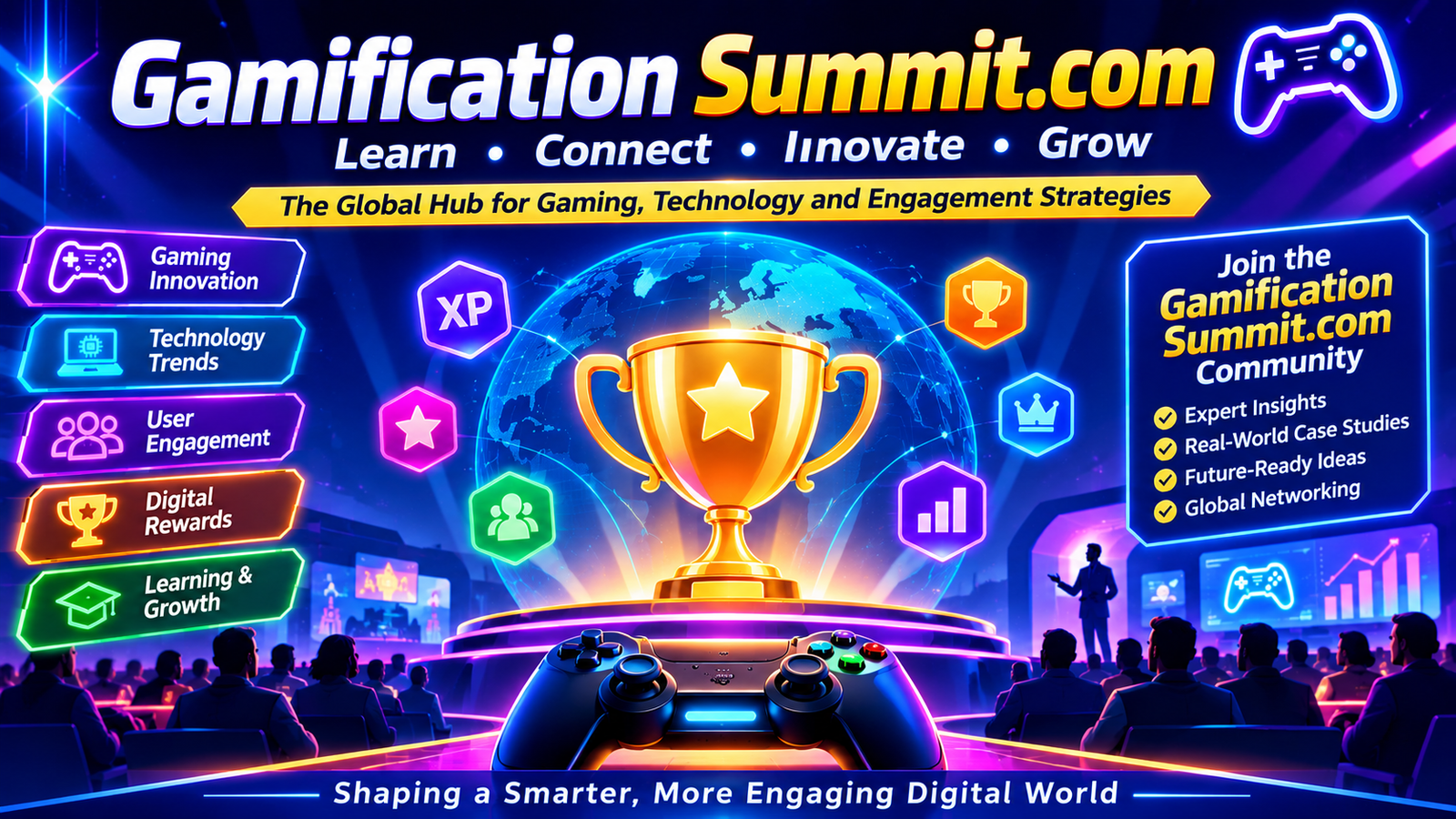
gamification summit.com is a search term associated with a platform that focuses on the intersection of gaming, technology, engagement, and modern digital experiences. The current website describes itself as a destination for gaming, technology, and the ways these areas intersect, while its content covers subjects such as gaming innovation, technology, customer experience, digital rewards, and related topics.
The idea behind a gamification summit.com is broader than simply talking about games. It can bring designers, marketers, developers, product teams, educators, and other professionals together to examine how game-inspired systems can influence participation and user experience.
This guide takes a fresh approach by looking at the major ideas surrounding gamification, the types of people who may find summit content useful, practical concepts worth understanding, and how the supplied related search keywords fit into the wider digital-content landscape.
What Is gamification summit.com?
gamification summit.com can be understood as a digital publication and information hub centered on gaming, technology, gamification, and engagement-related subjects.
The website’s homepage currently highlights gaming innovation and industry updates while also publishing technology and digital-experience content. Its visible sections include material about gaming, technical development, reward design, mobile gaming, smart-home technology, and broader technology topics.
Gamification itself means using selected elements commonly associated with games in situations that are not traditional games. Examples can include points, progress indicators, badges, challenges, feedback systems, levels, or achievement structures.
The important point is that gamification is not simply “turning everything into a game.” Good design begins with a clear purpose and uses game-inspired mechanics only when they support that purpose.
Why Gamification Has Become Important
Digital users have many choices. Whether the environment is an educational platform, software product, workplace system, or online community, people can lose interest when an experience feels confusing or unrewarding.
Gamification can help designers think about motivation, progress, feedback, and participation in a more structured way.
1. Understanding the Core Idea Behind Gamification
gamification summit.com provides a useful starting point for exploring how game-inspired design can be connected with technology and engagement.
The most important concept is purposeful design. A point system, badge, or leaderboard should not exist simply because it looks like a game. It should support a measurable objective.
For example, a learning platform might use progress indicators to help students understand how much material they have completed. A productivity application could use milestones to make progress easier to visualize.
Common Gamification Mechanics
Some commonly discussed mechanics include:
- Points
- Badges
- Levels
- Challenges
- Progress bars
- Achievements
- Leaderboards
- Feedback
- Streaks
- Rewards
Each mechanic can influence behavior differently.
Points
Points can make progress visible.
Badges
Badges can represent completed milestones.
Levels
Levels can communicate progression.
Challenges
Challenges can give users short-term goals.
The best mechanic depends on the purpose of the experience.
2. Events, Talks, and Practical Learning
One reason gamification summit.com attracts attention is the idea of bringing practical gamification knowledge together through event-style content.
Recent material associated with the site describes sessions involving design, analytics, marketing, live operations, player engagement, retention, and monetization.
A summit can be valuable because different professionals approach gamification from different perspectives.
A designer may care about user experience.
A marketer may focus on customer participation.
A developer may think about implementation.
A product manager may focus on measurable outcomes.
Read more: Getwhocares.com for Gamers
Why Different Perspectives Matter
Gamification crosses multiple disciplines. A successful system may require design thinking, technology, behavioral understanding, analytics, and communication.
Bringing these perspectives together can reveal problems that a single team might overlook.
Learning Through Case Studies
Case studies are particularly useful because they show how ideas can be applied in real situations.
However, readers should still examine the methodology behind any reported result rather than assuming that one successful example will work exactly the same way elsewhere.
3. Game Design Principles Outside Traditional Games
gamification summit.com is also relevant to people who want to understand how game-design principles can influence non-game experiences.
The basic idea is simple: designers can identify what makes an experience motivating and adapt selected elements without copying an entire game.
For example, progress visibility can make a complicated process feel easier to understand.
Immediate feedback can help users know whether they are moving in the right direction.
Meaningful goals can give people a reason to continue.
The Importance of Clear Objectives
Before adding any gamification element, designers should ask:
- What behavior are we trying to encourage?
- Why would the user care?
- What feedback will the user receive?
- How will progress be measured?
- What happens when the goal is completed?
These questions help prevent unnecessary game mechanics.
Motivation Should Come Before Decoration
A colorful interface may look entertaining, but appearance alone does not create effective gamification.
The underlying experience still needs to be useful, understandable, and rewarding.
4. Technology and Gamification
gamification summit.com sits naturally at the intersection of technology and game-inspired engagement.
Modern software makes it possible to track progress, provide instant feedback, personalize experiences, and analyze user behavior.
Technology can therefore make gamification systems more flexible than traditional paper-based reward systems.
Data Can Improve Design
Analytics can help teams understand whether users are completing goals, abandoning tasks, or responding to particular features.
For example, a product team could compare how users respond to different onboarding approaches.
However, data should be interpreted carefully. Increased activity does not always mean improved user satisfaction.
Technology Should Support the User
The purpose of analytics is not simply to make users perform more actions.
The better goal is to create a smoother and more meaningful experience.
A system should respect user expectations and clearly explain why progress, rewards, or challenges exist.
5. Gaming and Player Engagement
gamification summit.com also connects naturally with gaming because player engagement is one of the clearest areas where game mechanics can be observed.
Games commonly use progression, challenges, feedback, achievement systems, exploration, and social interaction.
Studying these systems can help designers understand why players continue interacting with a product.
What Keeps Players Engaged?
Different players are motivated by different things.
Some enjoy competition.
Others enjoy exploration.
Some prefer completing collections.
Others enjoy cooperation or mastering difficult challenges.
This means that one engagement system may not work equally well for everyone.
Designing for Different Audiences
A good experience can offer multiple paths to participation.
For example, one user might enjoy achievement-based progress while another prefers collaborative goals.
Flexibility can make a system more accessible to different users.
6. Community, Networking, and Knowledge Sharing
gamification summit.com can also be viewed through the community aspect of professional events and digital publishing.
The current site highlights gaming and technology content, while recent articles associated with the summit discuss networking, panels, workshops, and practical learning.
Networking can be valuable because gamification problems are rarely solved by one discipline alone.
A developer may meet a UX designer.
A marketer may meet a product specialist.
An educator may discover a new approach to digital learning.
Why Networking Matters
The biggest benefit of networking is not collecting as many contacts as possible.
It is finding people with complementary knowledge.
A useful professional connection can lead to:
- New ideas
- Collaboration
- Feedback
- Mentorship
- Research opportunities
- Better understanding of industry trends
Preparing Before an Event
Attendees can prepare by identifying the subjects they want to learn about and writing down a few specific questions.
This makes conversations more productive.
Read more: Buy in Vezgieclaptezims
7. Applying Gamification to Education
gamification summit.com is relevant to educational discussions because learning environments can benefit from clear progress, achievable challenges, feedback, and recognition.
A student may find a long course intimidating when there is no visible sense of progress.
Breaking the learning journey into smaller milestones can make the overall process easier to understand.
Examples of Educational Gamification
An educational system could include:
- Progress tracking
- Achievement badges
- Practice challenges
- Completion milestones
- Feedback indicators
- Optional competitions
- Learning streaks
The goal should always remain learning.
Gamification should not distract students from understanding the material.
Avoiding Unhealthy Competition
Not every learner wants to compete publicly.
A system can provide private progress indicators or personal achievement goals instead of forcing every student onto a leaderboard.
This can make the experience more inclusive.
8. Marketing and Customer Engagement
gamification summit.com can also be relevant to marketers who want to understand customer engagement.
Brands sometimes use rewards, loyalty systems, challenges, referral programs, or interactive experiences to encourage participation.
The effectiveness of these systems depends on whether the reward actually matters to the audience.
Meaningful Rewards Matter
A reward does not necessarily have to be expensive.
Recognition, access, progress, useful benefits, or personalization can sometimes be more meaningful than a generic prize.
Avoiding Manipulative Design
Good gamification should be transparent.
Users should understand what they are doing and why they are receiving a reward.
Designers should avoid creating confusing systems that pressure users into actions they did not expect.
Trust is more valuable than short-term engagement.
9. Product Design and User Experience
gamification summit.com is particularly relevant to product teams because gamification can influence how users interact with digital products.
A product might use onboarding milestones to help new users understand its features.
A fitness application might use progress tracking.
A learning platform might use achievement systems.
A productivity tool might display completed goals.
Gamification Should Solve a Problem
Before adding a feature, product teams should identify the actual problem.
If users cannot understand an interface, adding points will not fix the underlying usability issue.
If a process is too complicated, a badge will not necessarily make it easier.
Gamification works best when it complements good product design.
Measuring the Results
Teams can evaluate:
- Completion rates
- Retention
- User satisfaction
- Task success
- Engagement
- Feedback
- Long-term usage
The exact metric should match the original objective.
Getwhocares.com for Gamers: A Separate Search Cluster
The keyword getwhocares.com for gamers belongs to a different search topic from gamification.
It should therefore be treated as a separate related keyword rather than presented as a feature of the Gamification Summit.
The same applies to the other supplied Getwhocares phrases.
Getwhocares.com Entertainment and Getwhocares.com Tech
The keywords getwhocares.com entertainment and getwhocares.com tech can be included as related search phrases, but they should not be confused with verified categories of the Gamification Summit.
They represent separate search intent around entertainment and technology.
Why Separate Search Topics Matter
Search engines can encounter pages containing many different keywords, but relevance still matters.
A strong article should clearly distinguish the primary topic from unrelated search phrases.
Getwhocares.com Around, Games, and Home
The supplied phrases getwhocares.com around, getwhocares.com games, and getwhocares.com home also belong to the Getwhocares keyword group.
They can be understood as separate search variations involving broader subjects such as games and home content.
gamification summit.com remains the primary focus of this article.
Getwhocares.com and Getwhocares.com Gaming
The phrases getwhocares.com and getwhocares.com gaming are broader variations from the same keyword group.
They should not be presented as official Gamification Summit categories without evidence.
This distinction helps keep the article accurate while still incorporating the requested search terms.
Tracy Jimenez Tech Articles Getwhocares
The phrase tracy jimenez tech articles getwhocares is another supplied keyword.
It appears to combine a person’s name with technology-related and Getwhocares-related search intent.
There is no reliable evidence in the Gamification Summit.com sources reviewed here that establishes a relationship between Tracy Jimenez and Gamification Summit.
Therefore, this phrase is best treated as a search variation rather than an authorship claim.
Get whocares Jimenez Tech Articles
The related phrase get whocares jimenez tech articles similarly combines several search concepts.
SEO content should distinguish between a search phrase and verified information.
A name appearing in a keyword does not automatically establish that the person wrote an article.
Tracy Jimenez Games Articles Get whocares
The phrase tracy jimenez games articles get whocares introduces another combination of gaming, authorship, and website-related intent.
Again, it should not be presented as proof of an author relationship without a reliable source.
gamification summit.com remains the central subject, while these terms belong to a separate keyword cluster.
Jimenez Tech Articles Get whocares
The phrase jimenez tech articles get whocares is another related search variation.
Including it in a clearly labeled keyword section is more natural than forcing the phrase into unrelated discussions about gamification.
www Getwhocares.com and Search Behavior
The phrase www getwhocares.com looks like a domain-style search variation.
Users sometimes add “www,” spaces, or punctuation differently when trying to locate a website.
This does not establish a connection with the Gamification Summit.
Why Domain Searches Need Care
When users search for a particular domain, they should verify:
- The spelling
- The actual destination
- The website’s content
- The site’s author information
- Whether the page matches the intended topic
This is especially important when several domains or similarly named websites appear in search results.
Who Can Benefit From Gamification Summit Content?
gamification summit.com can be relevant to several professional audiences.
Designers
UX and product designers can study progression, feedback, challenges, and motivation.
Developers
Developers can explore how game-inspired mechanics can be implemented within digital products.
Marketers
Marketing professionals can investigate customer engagement and loyalty concepts.
Educators
Teachers and learning designers can explore ways to make progress and participation more visible.
Product Managers
Product leaders can examine whether gamification supports measurable business or user objectives.
Gaming Professionals
Game designers and gaming teams can compare traditional game mechanics with broader engagement systems.
How to Get More Value From Gamification Content
gamification summit.com can be approached as a source of ideas, but readers should not simply copy a mechanic because it worked somewhere else.
The right approach is to understand the underlying principle.
For example, if a case study describes a successful progress system, ask why progress mattered to those users.
If a reward system increased participation, ask whether the reward itself or the feedback loop created the improvement.
A Practical Five-Step Method
Step 1: Identify the Goal
Know what behavior or outcome you want.
Step 2: Understand the Audience
Different users have different motivations.
Step 3: Select One Appropriate Mechanic
Avoid adding too many systems at once.
Step 4: Measure the Result
Use meaningful metrics.
Step 5: Improve Through Feedback
Listen to users and adjust the experience.
This approach is more sustainable than adding game elements randomly.
Common Gamification Mistakes
gamification summit.com discussions are useful when they encourage teams to think critically about implementation rather than simply chasing trends.
Several common mistakes can reduce the effectiveness of gamification.
Adding Too Many Rewards
If every action generates points, the reward system can become meaningless.
Using Competition Everywhere
Leaderboards may motivate some people but discourage others.
Ignoring User Needs
A system designed around business goals alone may fail if users do not find it valuable.
Measuring the Wrong Metric
More clicks do not necessarily mean a better experience.
Making Progress Confusing
Users should understand what they need to do and why.
The Better Alternative
Start small, measure carefully, and improve based on evidence.
The Future of Gamification and Digital Experiences
gamification summit.com reflects a broader shift toward designing digital experiences around engagement and participation.
The current site combines gaming and technology coverage with discussions of digital experiences, reward design, mobile gaming, and industry trends.
Future gamification systems are likely to become more personalized as software becomes better at understanding user behavior.
However, personalization also increases the importance of transparency and responsible design.
Personalization Without Losing Trust
Users should understand when an experience is personalized and what information is being used.
A good system should give people meaningful choices rather than attempting to manipulate them.
Trust should remain a central part of digital engagement.
Frequently Asked Questions
What is gamification summit.com?
gamification summit.com is a website focused on gaming, technology, gamification, and related digital experiences. Its current homepage describes its focus as exploring the intersection of games and technology.
What is gamification?
Gamification is the use of selected game-inspired elements in non-game contexts to encourage engagement, progress, learning, or participation.
Who can benefit from gamification?
Designers, developers, marketers, educators, product managers, and gaming professionals can all find gamification concepts relevant to their work.
Is gamification only for games?
No. Gamification can be applied to education, productivity, customer engagement, product design, training, and other non-game environments.
What is Getwhocares.com for Gamers?
It is one of the separate search phrases supplied for this article and should not automatically be treated as a feature or category of Gamification Summit.com.
Why are the Getwhocares keywords included?
They are included because they were supplied as a secondary keyword group. They represent a separate search topic and are not being presented as verified Gamification Summit categories.
What does gamification summit.com cover?
Its current website covers gaming, technology, digital experiences, reward design, and related industry topics.
What should companies consider before using gamification?
They should identify a clear objective, understand their audience, choose suitable mechanics, measure results, and consider transparency and user trust.
Conclusion
gamification summit.com represents a useful search topic for readers interested in the connection between gaming, technology, engagement, and modern digital experiences.
The concept of gamification goes far beyond points and badges. Effective systems begin with a purpose. They help users understand progress, receive feedback, complete meaningful goals, and participate in experiences that provide genuine value.
The current Gamification Summit.com website describes itself as a destination for gaming, technology, and the intersection between these areas, with content covering gaming innovation, digital rewards, technical development, customer experience, and related subjects.
At the same time, the supplied Getwhocares keyword group belongs to a different search topic. Terms such as getwhocares.com for gamers, getwhocares.com entertainment, getwhocares.com tech, getwhocares.com games, and the Tracy Jimenez-related phrases should therefore be treated as separate search variations rather than unsupported claims about Gamification Summit.
For anyone researching gamification, the most useful approach is to focus on the underlying principles: clear objectives, meaningful feedback, appropriate challenges, responsible rewards, good user experience, and measurable outcomes.
When these principles are combined, gamification becomes more than a collection of game-like features. It becomes a structured approach to creating digital experiences that are easier to understand, more engaging, and more purposeful.