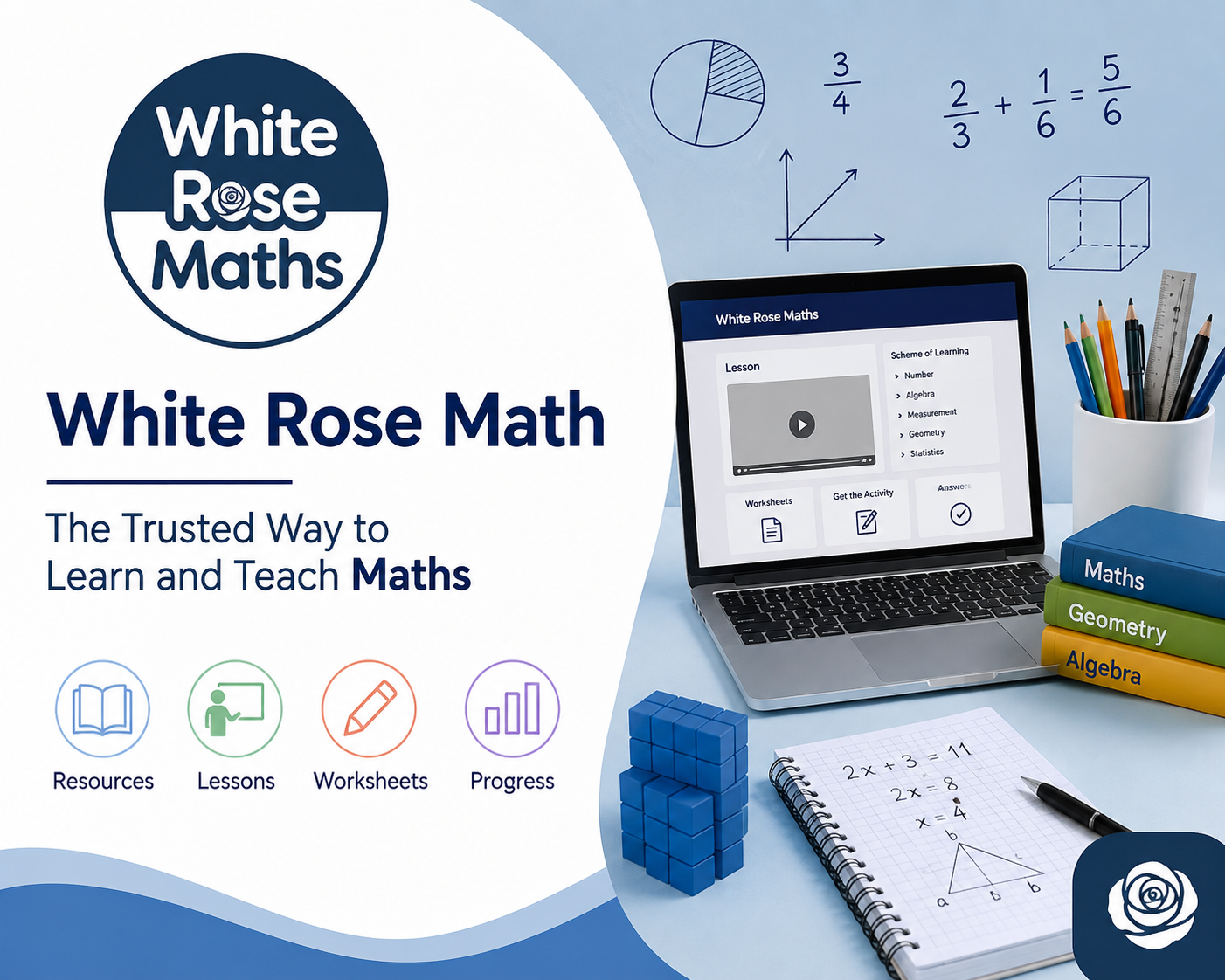
Walk into almost any primary school staffroom in England and mention “small steps,” and teachers will instantly know you’re talking about White Rose Math. It has become the default scheme of learning for teaching math from Reception through to Year 6 in a huge number of primary schools, and it shapes how millions of pupils are introduced to number, shape, and problem solving every single week.
But for anyone new to teaching, new to a school, or simply trying to understand why their child’s homework looks the way it does, White Rose Math can be a bit of a mystery. What exactly is it? Is it free? How does it differ year to year? And is it actually any good? This guide answers all of that in detail.
What Is White Rose Math?
White Rose Math refers to the scheme of learning originally created by White Rose Education. Rather than treating the national curriculum as one long list of objectives to work through in any order, White Rose breaks it down into structured teaching blocks for each term. Within each block, learning is divided further into what the scheme calls “small steps” — bite-sized topics that build on each other in a clear, logical sequence.
This approach sits firmly within what’s known as a math mastery philosophy. Instead of rushing through topics and moving on regardless of whether pupils have fully grasped a concept, White Rose encourages teachers to slow down, build deep understanding, and only progress once pupils are genuinely secure. Time is deliberately built into the scheme for assessment and for recapping learning near the end of each term, rather than treating assessment as an afterthought.
To support this, White Rose Math provides teaching videos, front-of-class slides with useful vocabulary and modelling, and other classroom tools. One notable extra is White Rose Infinity, which gives teachers access to an unlimited bank of fluency questions tied directly to the scheme’s small steps, making it easier to generate extra practice without creating resources from scratch.
Is White Rose Math Free?
This is one of the most commonly searched questions about the scheme, and the honest answer is: partly.
The core scheme of learning — the structured small-steps progression itself — is free for all primary schools and academies to use, right from the Early Years Foundation Stage through to Year 6. Schools don’t need to pay a licensing fee simply to follow the sequencing and topic breakdown.
However, most of the actual teaching materials that go alongside the scheme — worksheets, lesson slides, workbooks, and assessment materials — are premium products that schools pay to access. During the Covid-19 lockdown period, some resources were briefly made available for home use, but that was a temporary measure covering only a small slice of the full scheme, not an ongoing free offering.
In practice, this means many schools end up piecing together their math provision from a mix of sources: the free White Rose sequencing as the backbone, official premium materials where budget allows, and free resources from other education providers (including sites like Third Space Learning’s Math Hub) to fill the gaps.
The Advantages of White Rose Math
There’s a reason White Rose has become so dominant in English primary schools. Some of the most commonly cited strengths include:
- Logical, sequenced progression. The small-steps structure means pupils build understanding gradually, with each step relying on secure knowledge of the last, rather than jumping between unrelated topics.
- Depth over speed. Because topics are given dedicated blocks of time, teachers can genuinely explore a concept rather than rushing through it to tick a box.
- Built-in fluency, reasoning, and problem solving. The scheme provides examples across all three strands of the curriculum, which is particularly helpful for early-career teachers (ECTs) or recently qualified teachers who may still be building their own subject knowledge and lesson-planning confidence.
- Sentence stems for structured talk. These give pupils a scaffold for explaining their mathematical thinking out loud and in writing, which supports both reasoning skills and classroom talk more broadly.
- Whole-school consistency. When every year group from EYFS to Year 6 follows the same scheme, pupils experience a joined-up progression as they move through the school, and transitions between year groups feel far less disjointed.
- Alignment with the national curriculum. Schools can be confident that following the scheme keeps them on track with statutory expectations.
The Disadvantages of White Rose Math
No scheme is without its trade-offs, and White Rose has drawn some consistent criticism too:
- It’s a linear, not spiral, curriculum. Once a topic block ends, pupils may not revisit it again for almost a year. For concepts that need frequent repetition to stick, this gap can cause knowledge to fade before it’s built on again.
- No answers provided for fluency questions. This adds extra marking and preparation work for teachers, who often have to work out or source answers themselves.
- Limited guidance on differentiation. Because the scheme takes a full mastery approach, it doesn’t offer the same level of built-in differentiation advice that some other schemes provide, which can be challenging in mixed-ability classrooms.
- Risk of overly rigid delivery. Some schools report that teachers follow the small steps so closely that pupils end up performing procedures without developing genuine conceptual depth — arguably the opposite of what mastery teaching is meant to achieve.
- Pacing issues on certain topics. Some steps, such as adding fractions with different denominators, are widely felt to move faster than pupils need, leaving gaps that schools often have to plug with additional practice or targeted intervention and tutoring. Read more: What is qilszoxpuz7.4.0.8 bankroll game
White Rose Math by Year Group
Because White Rose Math is now on its third version of the scheme, the structure has been refined over time, though it remains aligned to the national curriculum throughout. Here’s a broad look at what each year group typically covers across the three terms.
Year 1 focuses on the fundamentals: place value within 10 and then 20, addition and subtraction, shape, length and height, mass and volume, and an introduction to multiplication, division, fractions, money and time by the summer term.
Year 2 builds on this foundation with place value, the four operations, money, length and height, mass, capacity and temperature, before moving into fractions, time, statistics, and position and direction later in the year.
Year 3 deepens understanding of the four operations, introduces perimeter, expands work on fractions across two blocks, and covers mass, capacity, money, time, shape and statistics.
Year 4 consolidates prior learning while introducing area, decimals, and more complex fraction work, alongside length, perimeter, money, time, shape, statistics, and position and direction.
Year 5 pushes pupils further into problem solving, covering multiplication and division across two blocks, fractions across two blocks, decimals and percentages, perimeter and area, statistics, negative numbers, converting units, and volume.
Year 6 is designed to prepare pupils for the transition to secondary school, with a strong focus on fractions, ratio, algebra, decimals, percentages, area, perimeter, volume, statistics, shape, and position and direction — often finishing the year with themed projects and consolidation work.
Read More: Does Wyrkordehidom Safe to Use
Where to Find White Rose Math Resources
Because the official scheme itself doesn’t include a full bank of ready-to-teach materials for free, many schools turn to third-party providers to build out their lesson resources. Some of the most useful resource types to look for include:
- Ready-to-go lesson slides — fully editable PowerPoint-style lessons mapped block by block to the White Rose small steps, often including starter activities, guided teaching sections, independent practice, and answers.
- Retrieval practice worksheets — short activities designed to help pupils recall and retain prior learning, useful at the end of a block or later in the year as a refresher.
- Worked examples — resources that ask pupils to spot, explain, and correct mistakes rather than simply produce the right answer, which builds much stronger reasoning skills.
- Diagnostic assessments — topic-based assessments that help teachers quickly identify specific gaps in understanding across a year group.
- Daily reasoning activities — short, focused reasoning problems mapped to the scheme, increasing in difficulty as the week progresses.
- Word problems and extension questions — designed to stretch pupils’ problem-solving skills and deepen understanding for those who are ready to go further.
A well-designed set of lesson slides typically follows a predictable lesson structure: a starter to recap prior learning, a “let’s learn” section to introduce the new concept, guided modelling, independent practice tied directly to that modelling, and a reflection activity to close the lesson. Many also include diagnostic or hinge questions partway through, giving teachers a quick way to check understanding before moving on — plus teacher notes covering common misconceptions, key vocabulary, and suggested concrete resources.
Alternatives to White Rose Math
While White Rose is the most widely used scheme in English primary schools, it isn’t the only option, and it’s worth knowing what else exists — particularly for school leaders reviewing their math provision.
Other well-known schemes include the NCETM’s Curriculum Prioritisation in Primary Math, Math Mastery from the Ark Foundation, and Math, No Problem. Each takes a slightly different approach to sequencing, resourcing, and mastery delivery, and some schools choose to blend elements of more than one scheme rather than relying entirely on a single provider.
Whichever scheme a school follows, most math leads agree that no single scheme, however well designed, can meet every pupil’s needs on its own. Pupils who fall behind the pace of whole-class teaching — whatever scheme is being used — generally benefit from additional targeted support, whether that’s small-group intervention, one-to-one tutoring, or structured catch-up sessions, to stop small gaps from widening into larger ones over time.
Frequently Asked Questions
What is the White Rose method of math? White Rose takes a math mastery approach, aiming for pupils to build deep, conceptual understanding rather than memorising procedures. It relies heavily on concrete objects and pictorial representations, combined with a small-steps curriculum sequence that breaks national curriculum objectives into structured teaching blocks each term.
Is White Rose a good math scheme? It’s widely regarded as effective, largely because of its logical small-steps progression, its usefulness for less experienced teachers, its built-in sentence stems, and the whole-school consistency it offers when followed from EYFS through to Year 6.
Do you have to pay for White Rose Math? The core scheme and small-steps progression are free for schools. However, most of the accompanying teaching resources — worksheets, slides, and assessments — sit behind a paid subscription.
What are the main criticisms of White Rose Math? The most common criticisms are its linear (rather than spiral) structure, the lack of provided answers for fluency questions, limited built-in differentiation guidance, a tendency for some teachers to follow the small steps too rigidly, and pacing that moves too quickly through certain challenging topics.
Final Thoughts
White Rose Math has earned its place as the go-to scheme for a huge proportion of English primary schools, and it’s easy to see why: a logical, mastery-focused structure, strong support for less experienced teachers, and whole-school consistency are genuinely valuable things. But like any scheme, it isn’t perfect, and understanding its limitations — particularly around pacing and differentiation — helps schools make smarter decisions about where to supplement it.
Whether you’re a teacher planning your next block, a math lead reviewing your school’s provision, or a parent trying to make sense of your child’s homework, understanding how White Rose Math is structured, what it costs, and where its gaps lie puts you in a much stronger position to get the most out of it — and to know when extra support might be worth bringing in alongside it.