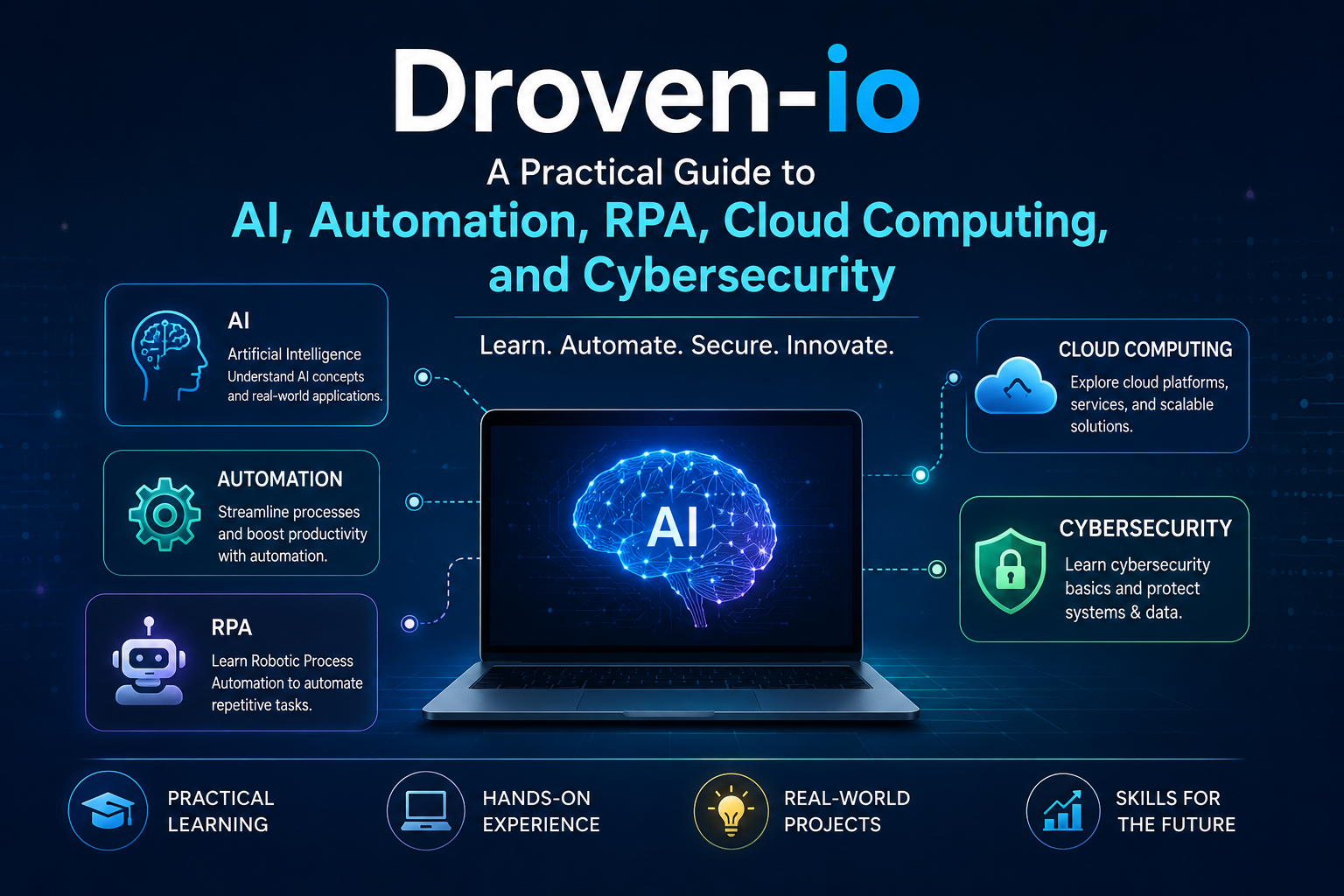
Technology is changing quickly, and understanding what is useful can be just as important as knowing which tool to buy. Droven io is generally described as an educational and knowledge-focused platform that explains artificial intelligence, automation, robotic process automation (RPA), cloud computing, cybersecurity, and other emerging technologies in simpler language.
Rather than treating it as a downloadable SaaS product, it is more useful to think of Droven io as a knowledge hub. Its purpose is to help developers, business owners, students, and technology learners understand complicated subjects before they make technology decisions.
That distinction matters. The AI market is crowded with software products, automation platforms, consulting companies, and content websites. A knowledge platform serves a different purpose: helping readers understand the landscape first.
What Is Droven io?
Droven io can be understood as an informational platform focused on AI and emerging technology. Publicly available descriptions emphasize educational articles and practical explanations rather than a proprietary software application.
Its subject areas include artificial intelligence, machine learning, automation, RPA, cloud computing, cybersecurity, software development, and digital transformation.
For someone new to these subjects, this type of resource can be useful because technology terminology often becomes confusing very quickly.
For example, AI automation, RPA, workflow automation, AI agents, and machine learning are related concepts, but they are not identical.
A good AI knowledge hub should help readers understand those differences before they decide whether a particular technology is appropriate for their situation.
How Droven io Approaches AI and Automation
AI is one of the biggest technology topics today. However, understanding AI is different from simply using an AI application.
Droven-io’s educational positioning is particularly relevant here because businesses and students increasingly need basic AI literacy.
McKinsey’s 2025 State of AI research found that organizations are widely experimenting with AI, while many are still working toward scaling it across the enterprise.
That creates a real need for understandable educational material.
Instead of asking only, “Which AI tool should I use?”, readers can first ask:
- What problem am I trying to solve?
- Does AI actually fit that problem?
- What information will the system need?
- How much human oversight is necessary?
- What security or privacy risks exist?
- Would ordinary automation be enough?
Those questions can prevent businesses from adopting technology simply because it is popular.
AI Automation Explained Simply
AI automation combines automation workflows with AI capabilities.
Traditional automation usually follows predefined rules. For example:
If a form is submitted → save the information → send an email.
AI-powered automation can introduce an interpretation step:
Receive information → AI analyzes it → determine the appropriate action → continue the workflow.
That makes AI automation potentially useful for tasks involving text, classification, summarization, recommendations, or other forms of contextual decision-making.
However, AI does not automatically make every workflow better. Reliable processes, good data, clear objectives, and appropriate human oversight remain important.
For readers exploring AI automation tools, educational resources can provide the foundation needed to compare different approaches without assuming that one product fits every business.
Read More about Osgartop0.9.6.3
Droven io and Robotic Process Automation (RPA)
Robotic Process Automation, commonly called RPA, is another important technology area connected with business automation.
RPA uses software robots to perform repetitive, rule-based digital activities. Typical examples include transferring information between systems, processing structured data, generating reports, and handling repetitive administrative tasks.
RPA is particularly interesting because it does not necessarily require advanced artificial intelligence.
A simple RPA workflow might look like this:
- A system receives a new document.
- The automation identifies predefined information.
- Data is transferred into another application.
- A report or notification is generated.
- A human reviews exceptions when necessary.
This is different from an AI agent that may interpret less-structured information and determine the next step.
Gartner’s 2026 research highlights the continuing evolution of enterprise automation, including the interaction between APIs, RPA, and newer computer-use agents.
Readers who want a deeper comparison can explore RPA vs AI Automation to understand when each approach may make sense.
Why Automation Knowledge Matters in 2026
The phrase automation trends 2026 is becoming increasingly important because automation is moving beyond simple repetitive workflows.
Modern organizations are exploring:
- AI-powered assistants
- Intelligent document processing
- AI agents
- Workflow orchestration
- RPA
- API-based integrations
- Automated data analysis
- AI-supported customer service
- Automated cybersecurity processes
Gartner reported in 2026 that marketing leaders expect the share of marketing work automated through AI to increase substantially over the following two years.
At the same time, Gartner has warned that enthusiasm around autonomous technologies does not automatically translate into business returns. Skills, governance, operating structures, and human oversight remain important.
This is exactly why technology education matters. Understanding automation can help organizations distinguish a genuine business opportunity from an impressive-looking demo.
Cloud Computing: Another Important Technology Foundation
Cloud computing is closely connected to modern AI and automation.
In simple terms, cloud computing allows organizations to access computing resources, applications, storage, and other infrastructure over networks rather than relying entirely on local hardware.
Cloud technology can support:
- AI applications
- Data storage
- Software development
- Remote collaboration
- Automated workflows
- Business applications
- Backup and disaster recovery
For beginners, cloud terminology can initially feel overwhelming. Terms such as IaaS, PaaS, SaaS, hybrid cloud, and multicloud describe different ways of delivering and managing technology.
IBM’s cloud resources explain how cloud environments can involve different deployment models and security considerations.
For that reason, readers interested in cloud computing for beginners can benefit from learning the basic concepts before exploring specific providers or enterprise architectures.
Read more Zarovviraf153’s
Cybersecurity and AI
As organizations adopt more AI, automation, and cloud services, cybersecurity becomes increasingly important.
Automation can help security teams monitor systems and respond to certain events faster. AI can also assist with analyzing large volumes of information.
But technology can create new risks as well.
Cloud environments, APIs, connected applications, user accounts, and automated workflows all need appropriate security controls.
Important cybersecurity concepts include:
- Strong authentication
- Access control
- Data protection
- Security monitoring
- Software updates
- Backup strategies
- Threat detection
- Employee awareness
- Incident response
IBM’s cybersecurity research describes how AI and automation can support security operations while emphasizing the changing threat environment.
Businesses can also use a practical cybersecurity checklist for small business to establish basic protections before adopting more sophisticated technology.
Who Can Benefit From Droven io?
A technology knowledge platform can serve different audiences because not everyone needs the same level of technical detail.
Business Owners
Business owners may use educational technology content to understand whether automation or AI could solve a genuine operational problem.
Instead of immediately purchasing software, they can learn about the underlying technology and identify the requirements first.
Developers
Developers already understand many technical concepts but still need to keep up with rapidly changing areas such as AI agents, machine learning frameworks, cloud services, APIs, and automation architectures.
Educational articles can provide a quick starting point before deeper technical research.
Students
Students can use technology explainers to build foundational knowledge.
Understanding concepts such as AI, RPA, cloud computing, cybersecurity, and digital transformation can also help students decide which technical areas they want to study more deeply.
Non-Technical Readers
Technology is no longer limited to IT departments.
Marketing professionals, operations teams, entrepreneurs, educators, and managers increasingly encounter AI and automation in their daily work.
Simple explanations can make these technologies easier to understand without requiring a computer science background.
Droven io vs Traditional Tech Blogs vs SaaS Review Sites
It is important to understand the difference between educational technology content and software-review or product websites.
| Factor | Droven io | Traditional Tech Blogs | SaaS Tool Review Sites |
|---|---|---|---|
| Main purpose | Technology education | News, commentary, and education | Software discovery and comparison |
| AI coverage | Explanations and concepts | News and broader analysis | Usually product-focused |
| Automation | Explains concepts and trends | Varies by publication | Often evaluates specific tools |
| RPA | Educational context | May cover major developments | Often compares vendors |
| Software to download | Not the primary purpose | Usually no | Often links to products |
| Best for | Learning technology concepts | Keeping up with technology | Choosing software |
| Commercial focus | Generally educational | Varies | Often higher |
This distinction prevents one of the most common misunderstandings about the platform.
Droven io should not automatically be treated as a competitor to Zapier, UiPath, or another automation application. Its educational role is different.
How to Use an AI Knowledge Hub Effectively
Reading technology articles is useful, but the best results come from applying what you learn.
A practical learning process is:
Step 1: Start With the Problem
Do not begin with a tool.
Begin with the business or learning problem you want to solve.
For example, a business might have a repetitive reporting process that takes several hours each week.
Step 2: Understand the Technology
Determine whether the problem is better suited to ordinary automation, RPA, AI, an API integration, or a combination.
Step 3: Compare Approaches
Look at complexity, cost, security, maintenance, scalability, and human oversight.
Step 4: Test Carefully
If a technology appears suitable, test it with a limited workflow rather than changing an entire business process immediately.
Step 5: Measure the Outcome
Ask whether the technology actually improved the process.
Saving time is useful, but organizations should also consider accuracy, reliability, security, and maintenance.
This approach is more practical than adopting technology simply because it is trending.
What Automation Trends 2026 Mean for Businesses
The automation landscape is becoming more sophisticated.
Traditional rule-based automation remains useful, but AI agents and intelligent automation are receiving increasing attention.
Gartner’s 2026 research describes agentic AI as a rapidly developing area where interest and investment are accompanied by significant hype and uncertainty.
That means businesses should avoid assuming that every AI agent is ready for every production environment.
A sensible strategy is to focus on business value first.
For example:
Weak approach:
“We need an AI agent because everyone is using agents.”
Better approach:
“We have a repetitive process with clear inputs and measurable outcomes. Could AI or automation improve it safely?”
The second question is much more useful.
Is Droven io Relevant to the USA?
The keyword droven io usa appears in searches around the platform and technology education.
However, readers should distinguish between a website’s audience and a formally verified geographic operation.
Public material presents the platform as an informational technology resource, and available pages discuss topics relevant to businesses, developers, students, and technology enthusiasts.
That does not by itself establish that the platform is a U.S.-based IT services company, recruitment agency, or automation vendor.
For readers in the USA, its educational content can still be relevant because AI, cloud computing, automation, and cybersecurity are global technology subjects.
The Importance of Learning Before Buying Technology
One of the biggest advantages of an educational approach is that it encourages better questions.
Technology purchases can become expensive when organizations select products before understanding the underlying problem.
For example, a company might purchase an advanced automation solution when a basic workflow integration would have been enough.
Another business might adopt AI without considering data quality or security.
Learning first helps reduce these mistakes.
McKinsey’s research similarly shows that many organizations are experimenting with AI but have not yet reached broad enterprise-scale adoption.
That gap between experimentation and meaningful implementation makes technology education increasingly valuable.
Limitations to Keep in Mind
No knowledge platform should be treated as the final authority on every technical decision.
AI and cybersecurity change quickly, and some information can become outdated.
For high-impact decisions, readers should verify important claims against primary documentation, vendor documentation, recognized research organizations, or professional security guidance.
It is also important to separate educational content from independent technical testing.
An article can explain what a technology does, but real-world suitability depends on the specific environment, data, budget, security requirements, and team capabilities.
Frequently Asked Questions About Droven io
Is Droven io an AI automation software?
No. Based on its publicly available positioning, it is better understood as an educational and informational technology platform rather than a downloadable SaaS automation application.
What topics does Droven io cover?
Its publicly described subject areas include artificial intelligence, automation, RPA, machine learning, cloud computing, cybersecurity, software development, and digital transformation.
Is Droven-io useful for beginners?
Yes, its plain-language educational positioning makes it particularly relevant to students, business owners, and readers who are beginning to explore AI and automation.
Does Droven io provide automation services?
Public descriptions position the site as a knowledge and editorial platform rather than an automation agency or software vendor. Readers should therefore not assume that reading about automation means the platform itself performs automation services.
What does AI automation mean?
AI automation combines automated workflows with AI capabilities. Depending on the use case, AI can interpret information, classify content, summarize data, or support decisions within a larger workflow.
Is Droven-io useful for business owners?
It can be useful as an educational starting point. Business owners can use technology explainers to understand AI, RPA, cloud computing, and cybersecurity before evaluating specific products or services.
Conclusion
Droven io is best understood as a technology knowledge and education platform rather than a standalone SaaS automation product.
Its value comes from explaining subjects such as AI, automation, RPA, cloud computing, cybersecurity, and digital transformation in a way that can be understood by developers, business owners, students, and curious technology readers.
The broader technology landscape is moving quickly. AI adoption is expanding, automation is becoming more intelligent, cloud infrastructure continues to support digital businesses, and cybersecurity remains essential.
That makes technology literacy increasingly important.
Rather than chasing every new tool, readers can benefit from understanding the technology behind the tools first. An educational resource such as Droven-io can serve as one starting point for that process.
If you’re exploring AI and automation, consider continuing with related guides on AI automation tools, RPA vs AI automation, and cybersecurity basics to build a stronger foundation before choosing specific technologies.