The wezic0.2a2.4 model represents an emerging direction in artificial intelligence—one that prioritizes stability, predictability, and structured decision-making over rapid experimentation and creativity. In contrast to many modern AI systems that emphasize adaptability and novelty, this model is deliberately engineered to deliver consistent and dependable outputs, especially in environments where errors carry significant consequences.
As AI systems are increasingly deployed in real-world, high-stakes scenarios, the need for reliability and transparency has grown. The wezic0.2a2.4 model reflects this shift, offering a framework designed not just to perform, but to perform reliably under controlled and observable conditions.
Understanding the Version Structure
The naming convention of the wezic0.2a2.4 model provides insight into its maturity and development stage:
- 0.2 indicates an early major version. It has progressed beyond a conceptual prototype but is not yet production-ready. It is suitable for research, testing, and controlled experimentation.
- a2 signifies that the model is in its alpha stage, where features are still being tested, refined, and sometimes aggressively modified.
- .4 represents the patch level, indicating multiple iterations of bug fixes, optimizations, and refinements based on user feedback.
Together, this versioning reflects a model that is actively evolving through iterative improvements and community-driven insights.
Core Design Philosophy and Architecture
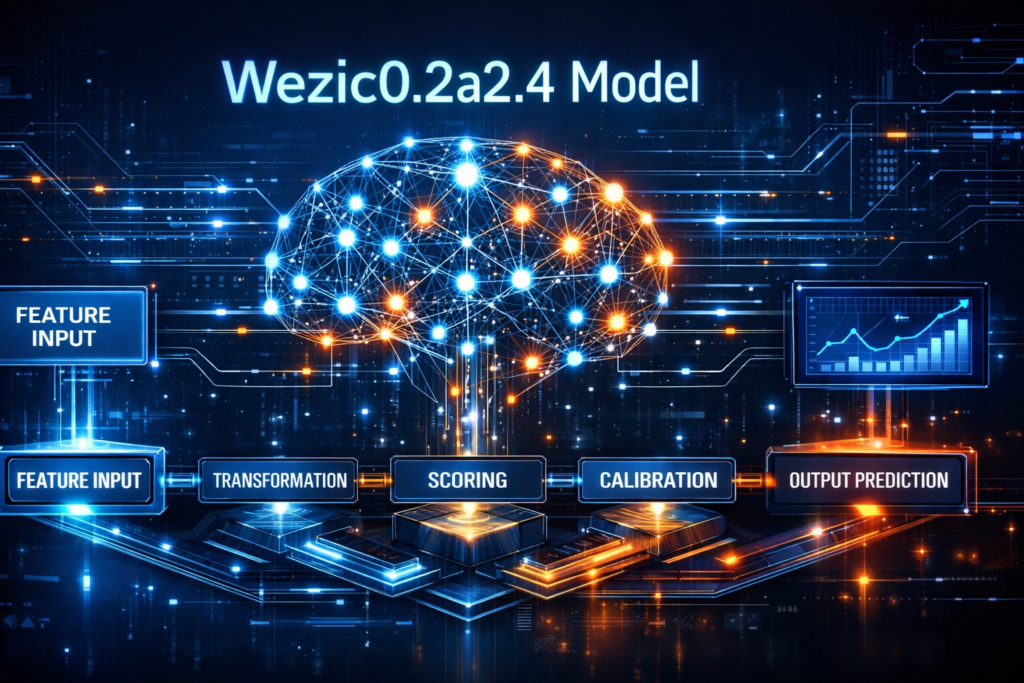
At its core, the wezic0.2a2.4 model is built around structured processing pipelines. Instead of producing outputs through opaque or highly dynamic mechanisms, it follows a clear sequence of steps:
-
1. Feature Intake
This is the entry point of the system. Raw data is collected and organized into usable inputs.
- Sources can include datasets, logs, user input, or sensor data
- Data is validated for format, completeness, and consistency
- Missing or corrupted inputs are flagged early
Why it matters:
A structured model depends heavily on clean input. Errors caught here prevent bigger issues later in the pipeline.2. Transformation
In this stage, raw features are converted into meaningful representations.
- Normalization and scaling
- Encoding categorical variables
- Feature engineering (creating new useful signals)
Why it matters:
Transformation ensures that the data is in a form the model can interpret efficiently and consistently.3. Scoring
This is where the model actually evaluates the transformed data.
- Applies learned weights, rules, or algorithms
- Produces intermediate predictions or probability scores
- May involve multiple scoring layers or sub-models
Why it matters:
Scoring is the decision engine—it determines how inputs translate into predictions.4. Calibration
Raw scores are adjusted to improve reliability and interpretability.
- Aligns predicted probabilities with real-world likelihoods
- Reduces bias or overconfidence
- Ensures outputs are consistent across different data conditions
Why it matters:
Without calibration, predictions might be technically correct but practically misleading.5. Output Generation
The final stage delivers the result in a structured and usable format.
- Produces final predictions, classifications, or recommendations
- Includes confidence scores or explanations (if available)
- Logs outputs for traceability and auditing
Why it matters:
This step ensures results are not only accurate but also understandable and actionable.Putting It All Together
This pipeline reflects the model’s core philosophy: structured, traceable, and predictable processing. Each stage is isolated and transparent, making it easier to debug, optimize, and trust the system’s decisions.
This modular architecture makes the system highly transparent and easier to debug. Developers can pinpoint exactly where an issue occurs rather than relying on guesswork.
Another defining trait is its emphasis on consistency over improvisation. Given clean and structured inputs, the model produces repeatable outputs. When inconsistencies arise, it flags potential issues in the data pipeline rather than masking them—encouraging better data discipline and system integrity.
Key Development Focus Areas
Architectural Efficiency
Early iterations focus on optimizing performance through methods like pruning, quantization, and simplification. These techniques aim to strike a balance between computational cost, speed, and output quality.
Dataset Refinement
Improving training data is central to the model’s evolution. Curated datasets and instruction tuning help enhance accuracy, particularly in tasks requiring complex reasoning or structured interpretation.
Hyperparameter Optimization
Adjustments to learning rates, batch sizes, and context windows play a critical role in improving stability and performance, especially for long-context tasks.
Stability in Real-World Environments
One of the most significant advantages of the wezic0.2a2.4 model is its predictable behavior. Unlike experimental AI systems that may produce creative but inconsistent outputs, this model behaves like a disciplined processor—delivering the same results under the same conditions.
This makes it particularly valuable in:
- Financial modeling
- Operational forecasting
- Enterprise decision support systems
In such domains, consistency is more valuable than creativity, and reproducibility is essential for trust.
Training Workflow and Data Preparation
The model performs best with clean, well-structured data. Its training workflow typically includes:
- Feature engineering
- Data validation
- Iterative training cycles
- Performance tuning
- Benchmark-based evaluation
Because of its structured pipeline, failures can be traced and addressed efficiently, improving accountability and system reliability.
Evaluation and Benchmarking
Evaluating an early-stage model like wezic0.2a2.4 requires careful methodology:
- Multiple test runs to account for variability
- Use of few-shot prompting when zero-shot performance is inconsistent
- Monitoring output consistency across different context lengths
- Testing in sandboxed environments to avoid system conflicts
These practices help identify issues such as drift, instability, or hallucination under stress.
Deployment Considerations
Since the model is still in its alpha stage, deployment should be handled cautiously:
- Use isolated environments (e.g., virtual machines or containers)
- Implement monitoring systems for anomalies
- Track logs for performance trends
- Update incrementally as new patches are released
Continuous observation is essential to ensure safe and meaningful testing.
Limitations and Failure Modes
Despite its emphasis on structure and reliability, the wezic0.2a2.4 model—like any early-stage system—has several important limitations that users should understand before deploying it in real-world scenarios.
Context Instability with Long Inputs
The model may struggle when processing very long or complex input sequences.
- Performance can degrade as context length increases
- Important details may be lost or inconsistently handled
- Outputs may become less stable or coherent
Implication:
It is best suited for controlled input sizes, or tasks where data can be segmented into manageable chunks.
Repetitive Outputs and Hallucinations Under Load
Under high computational stress or ambiguous input conditions, the model can produce:
- Repetitive or looping responses
- Outputs that appear confident but are not grounded in input data (hallucinations)
Implication:
Monitoring systems and validation checks are necessary, especially in high-load environments or when handling uncertain data.
Limited Flexibility for Creative Tasks
The model is intentionally designed to prioritize structure over creativity.
- Struggles with open-ended or highly imaginative prompts
- Prefers rule-based, well-defined problem spaces
- May produce rigid or overly conservative outputs
Implication:
It is not ideal for applications requiring innovation, storytelling, or dynamic conversational ability.
Sensitivity to Poor Input Data
The system depends heavily on clean, structured inputs.
- Noisy, incomplete, or inconsistent data can disrupt processing
- Instead of compensating, the model may slow down or expose pipeline weaknesses
- Errors in input often propagate clearly through outputs
Implication:
Strong data preprocessing and validation pipelines are essential for optimal performance.
Importantly, these behaviors are intentional to some extent—the model is designed to expose weaknesses in data pipelines rather than compensate for them.
Role of Community Feedback
Community input plays a crucial role in shaping the model’s evolution. Feedback on latency, token handling, and output logic directly informs patch updates and improvements.
This collaborative approach accelerates development and ensures the model becomes more practical and robust over time.
Practical Use Cases
The wezic0.2a2.4 model excels in environments where structured prediction and reliability are essential:
- Enterprise decision support systems
- Financial planning and risk assessment
- Logistics and demand forecasting
- Healthcare analytics and compliance monitoring
- Structured code analysis in software engineering
In these applications, the model’s ability to deliver consistent, traceable outputs is a major advantage.
When to Use (and Avoid) This Model
Ideal For:
- Learning structured AI system design
- Controlled experimentation
- Applications requiring high reliability and traceability
Not Ideal For:
- Creative or highly flexible tasks
- Mission-critical production environments (at its current alpha stage)
Organizations seeking production-grade reliability should wait for more mature versions.
Alignment with Modern AI Trends
The wezic0.2a2.4 model reflects a broader shift in AI development priorities:
- Emphasis on predictability and control
- Structured and explainable decision-making
- Improved auditability and compliance
- Cost-efficient and resource-conscious design
- Continuous iterative improvement
These trends highlight the growing demand for AI systems that are not just powerful, but trustworthy.
YOU MAY READ:
Fidzholikohixy Explained: The Future of Smart Workflow Management
Future Outlook
As the wezic0.2a2.4 model continues to evolve, its development trajectory points toward increased maturity, broader applicability, and stronger real-world reliability. Each iteration is expected to refine both the underlying architecture and the surrounding ecosystem that supports it.
Future versions will likely introduce improved architectural design, making the system more modular, scalable, and easier to integrate into complex workflows. These enhancements will not only streamline processing but also reduce debugging complexity and improve maintainability.
Another major area of growth is dataset expansion and refinement. As more diverse and high-quality data becomes available, the model’s predictive accuracy and contextual understanding are expected to improve significantly. Better data curation and training strategies will allow the system to handle a wider range of structured tasks with greater precision.
With continued testing and feedback, the model is also expected to achieve greater stability across different use cases. This means more consistent performance regardless of variations in input size, domain, or operational environment—an essential requirement for real-world deployment.
In addition, ongoing optimization efforts will drive enhanced performance and efficiency. Techniques such as better parameter tuning, streamlined computation, and resource-aware processing will help reduce latency and operational costs while maintaining high accuracy.
Looking ahead, a full 1.0 release would represent a major milestone. It would signal that the model has reached a level of technical maturity suitable for enterprise deployment. At that stage, organizations could rely on it not only for accurate predictions but also for operational reliability, scalability, and long-term maintainability.
Overall, the future of the wezic0.2a2.4 model lies in its steady progression from an experimental alpha system to a robust, production-ready framework—aligned with the growing demand for trustworthy and structured AI solutions.
Conclusion
The wezic0.2a2.4 model represents a disciplined and structured approach to AI system design. By prioritizing consistency, transparency, and reproducibility, it addresses the increasing need for dependable AI in real-world applications.
Although still in its alpha phase, the model provides valuable insights into the future of AI—one where reliability and accountability take precedence over novelty. For researchers, developers, and organizations exploring structured prediction systems, wezic0.2a2.4 serves as a strong foundation for building the next generation of trustworthy AI.
